A story turned devastatingly personal
Covering a celebrity's cancer scare led Winnipeg journalist to her own early diagnosis

Advertisement
Read this article for free:
or
Already have an account? Log in here »
To continue reading, please subscribe:

Digital Subscription
One year of digital access for only $205*
- Enjoy unlimited reading on winnipegfreepress.com
- Read the E-Edition, our digital replica newspaper
- Access News Break, our award-winning app
- Play interactive puzzles
*First annual payment billed as $205.00 + GST for one year. This annual subscription will automatically renew at $233.00 + GST every 52 weeks (10% off the regular annual price of $259.35). Offer available to new and qualified returning subscribers only. Cancel any time.
To continue reading, please subscribe:
Add Free Press access to your Brandon Sun subscription for only an additional
$1 for the first 4 weeks*
- Enjoy unlimited reading on winnipegfreepress.com
- Read the E-Edition, our digital replica newspaper
- Access News Break, our award-winning app
- Play interactive puzzles
*Your next Brandon Sun subscription payment will increase by $1.00 and you will be charged $17.95 plus GST for four weeks. After four weeks, your payment will increase to $24.95 plus GST every four weeks.
Read unlimited articles for free today:
or
Already have an account? Log in here »
Hey there, time traveller!
This article was published 18/01/2025 (629 days ago), so information in it may no longer be current.
Winnipeg-born reporter Alison Hall was diagnosed with breast cancer after covering actress Olivia Munn’s diagnosis.
Hall, 33, from River Heights, was reporting on Munn’s health scare and subsequent double mastectomy for U.S. newsmagazine Inside Edition.
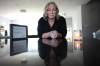
Supplied Alison Hall, who underwent a double mastectomy on Tuesday, wants to raise awareness of the tool.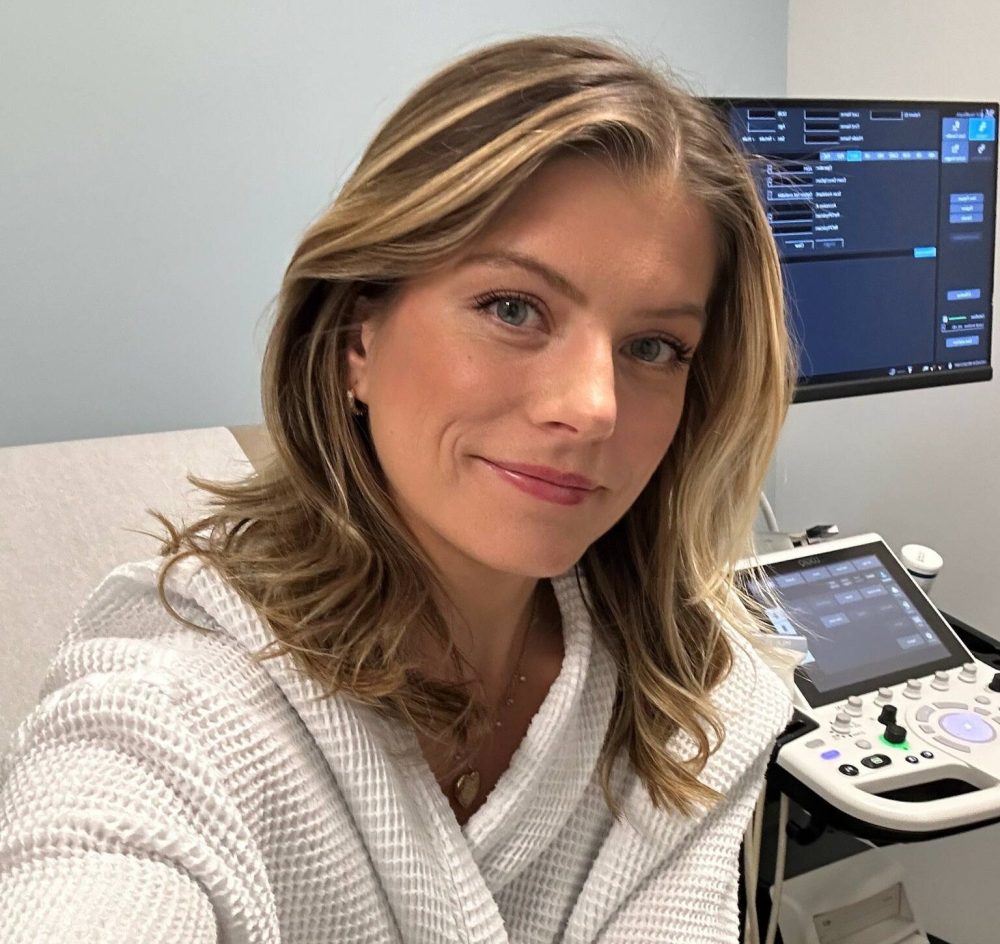
Munn was diagnosed after using the Breast Cancer Risk Assessment Tool (BCRAT), which showed she had a lifetime risk of 37 per cent for getting breast cancer.
Hall, who is based in New York City, took the same test during an on-camera interview with a breast cancer doctor at Lennox Hill Hospital in Manhattan. She was told her lifetime risk for breast cancer was 36 per cent.
Women are classified as high risk for developing breast cancer if they have a lifetime risk of 20 per cent or higher.
Now Hall, who underwent a double mastectomy last Tuesday, wants to raise awareness of the tool.
Also known as the Gail Model, the online calculator uses a woman’s personal medical and reproductive history alongside the history of breast cancer among first-degree relatives (mothers, sisters, daughters). Those factors are used to estimate her risk of developing invasive breast cancer over the next five years, and her estimated lifetime risk up to the age of 90.
Inside Edition Hall (right) looks at her own Breast Cancer Risk Assessment Tool (BCRAT) results.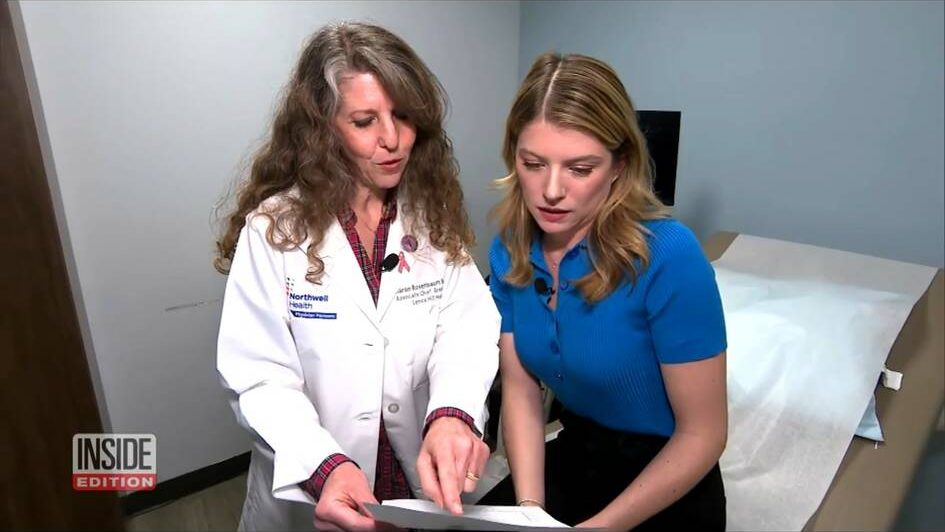
Hall had never heard of BCRAT before working on the story. Although typically administered by health-care professionals, the online test can be accessed by anyone.
“Because of my test result, my doctor was able to push for early screening. I was able to get a mammogram and an ultrasound, which revealed I had extremely dense breasts so a breast MRI was scheduled for six months later in October 2024,” she said.
On a mammogram, a cancerous tumour and dense breast tissue both present as white, creating a masking effect in women with dense breasts.
Hall’s doctor advised she should be on a regular screening schedule from then on.
“Being 32 at the time, I thought I would get multiple MRIs in my life and never get cancer. I was feeling really good and put it out of my mind,” she said.
“I was not expecting that it would change my life so quickly.”
However, the MRI results revealed the presence of cancerous cells, and Hall was diagnosed with stage zero breast cancer, also known as ductal carcinoma in situ. In DCIS, the cells that line the milk ducts turn cancerous but have not spread to the surrounding breast tissue.
Hall was not prepared for the swift diagnosis.
“I was not expecting that it would change my life so quickly. It would be nice if I didn’t have to go through it at all but also really amazing that it’s been caught so early when I have the opportunity to deal with it while I am young and healthy.
“I think some people might go, ‘Whoa a double mastectomy for stage zero seems like a lot’ but I think it’s important to note that being a young woman diagnosed with breast cancer this young, it’s really important for me not only to deal with the current cancer, but to reduce my risk down dramatically so that hopefully I never ever have to have those words, ‘You have breast cancer’ said to me again,” she said.
CBS Mornings ‘By telling your story,’ actress and cancer survivor Olivia Munn wrote to Alison Hall, ‘you’re creating a ripple effect of hope and saving lives.’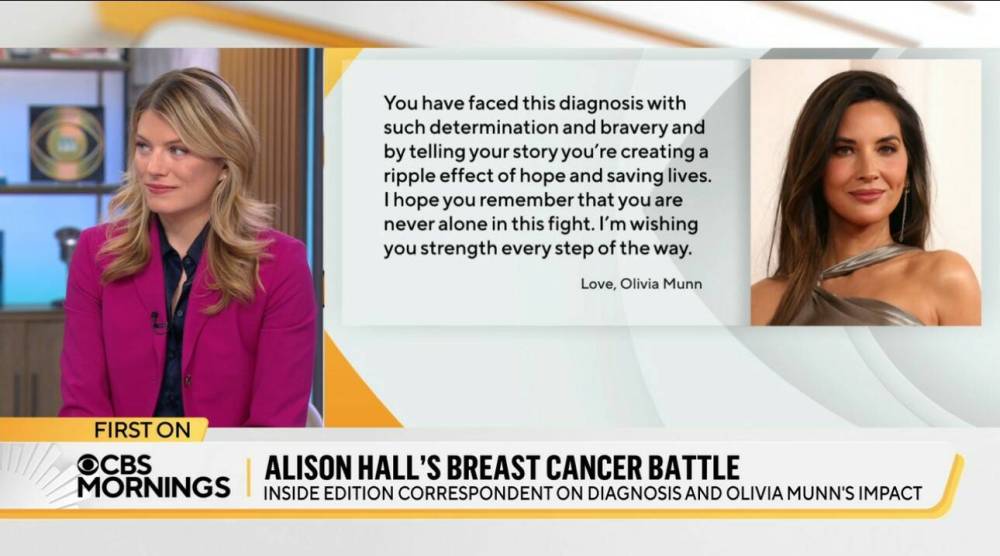
The BCRAT was created by Dr. Mitchell Gail, an adjunct professor at Johns Hopkins University and a principal investigator at the National Cancer Institute. His research focuses on creating models for determining absolute risk of diseases.
The online calculator can be accessed at bcrisktool.cancer.gov.
“Several tools have been validated for use in breast cancer risk assessment. These tools can be used by screening programs to invite and recall participants to screening, for breast-cancer surveillance, and in high-risk cancer programs.
“While the tools are publicly available, they are not typically used on their own. Instead, they are usually combined with a clinical assessment and imaging, for example mammography,” a spokesperson from CancerCare Manitoba said.
av.kitching@freepress.mb.ca

AV Kitching is an arts and life writer at the Free Press. She has been a journalist for more than two decades and has worked across three continents writing about people, travel, food, and fashion. Read more about AV.
Every piece of reporting AV produces is reviewed by an editing team before it is posted online or published in print — part of the Free Press‘s tradition, since 1872, of producing reliable independent journalism. Read more about Free Press’s history and mandate, and learn how our newsroom operates.
Our newsroom depends on a growing audience of readers to power our journalism. If you are not a paid reader, please consider becoming a subscriber.
Our newsroom depends on its audience of readers to power our journalism. Thank you for your support.
AV Kitching is an arts and life writer at the Free Press. She has been a journalist for more than two decades and has worked across three continents writing about people, travel, food, and fashion. Read more about AV.
Every piece of reporting AV produces is reviewed by an editing team before it is posted online or published in print — part of the Free Press‘s tradition, since 1872, of producing reliable independent journalism. Read more about Free Press’s history and mandate, and learn how our newsroom operates.
Our newsroom depends on a growing audience of readers to power our journalism. If you are not a paid reader, please consider becoming a subscriber.
Our newsroom depends on its audience of readers to power our journalism. Thank you for your support.
Related Articles
John Mulaney and Olivia Munn have a second child, a daughter named Méi

Advertisement Advertise With Us
Advertisement Advertise With Us