Analysis: China’s birth-rate struggles underscore its millennia-long effort to manage ‘the masses’
Advertisement
Read this article for free:
or
Already have an account? Log in here »
To continue reading, please subscribe:

Digital Subscription
One year of digital access for only $205*
- Enjoy unlimited reading on winnipegfreepress.com
- Read the E-Edition, our digital replica newspaper
- Access News Break, our award-winning app
- Play interactive puzzles
*First annual payment billed as $205.00 + GST for one year. This annual subscription will automatically renew at $233.00 + GST every 52 weeks (10% off the regular annual price of $259.35). Offer available to new and qualified returning subscribers only. Cancel any time.
To continue reading, please subscribe:
Add Free Press access to your Brandon Sun subscription for only an additional
$1 for the first 4 weeks*
- Enjoy unlimited reading on winnipegfreepress.com
- Read the E-Edition, our digital replica newspaper
- Access News Break, our award-winning app
- Play interactive puzzles
*Your next Brandon Sun subscription payment will increase by $1.00 and you will be charged $17.95 plus GST for four weeks. After four weeks, your payment will increase to $24.95 plus GST every four weeks.
Read unlimited articles for free today:
or
Already have an account? Log in here »
Hey there, time traveller!
This article was published 20/01/2026 (222 days ago), so information in it may no longer be current.
BEIJING (AP) — From ancient times until today, an enormous population has been a foundational way for China to project its strength. But anxiety about managing so many mouths has always loomed. “China has a population of 600 million people, and we must never forget this fact,” Mao Zedong said in 1957, shortly before setting off a calamitous famine.
China’s masses, though, are getting to be less massive. And that’s a problem.
Birth rate numbers released Monday, the lowest since Mao’s Communists established the People’s Republic in 1949, are the latest development in a millennia-long struggle in China, where producing children and refreshing the population of the young have been central to the national conversation since the country’s earliest days.

China’s population stands at 1.404 billion today, down 3 million from the previous year. And the central government’s challenge remains much as it has always been: to manage a citizenry that both enhances the country’s strength and claims enormous resources.
But various factors — policy, generational change and general evolution of the way people live — have officials concerned that there won’t be enough young Chinese people to build the tomorrow they want. This week’s numbers illustrate how complicated the problem remains.
The ripples of the one-child policy
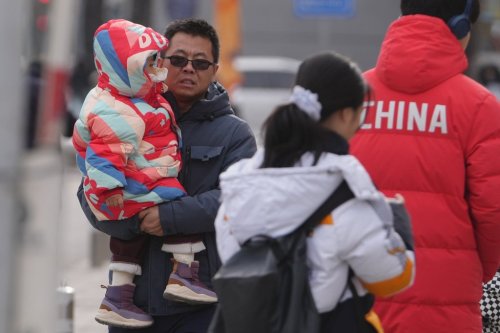
It’s likely that urban Chinese of the 1980s could barely imagine the situation today — a society where the government is pushing families to have more — up to three — children.
The one-child policy, officially instituted in 1980 four years after Mao’s death, was designed to curb a growing population. It restricted Chinese couples to a single offspring and eventually, in many cases, punished them if they didn’t comply. The rationale: At that time, under Deng Xiaoping’s policy of “reform and opening-up,” the country’s capital and resources couldn’t keep up with the population’s demands.
Beijing’s answer was to slow the population’s growth. Over time, that created a disproportionate amount of elderly people. “China’s demographic transition, characterized by people getting old before becoming rich, creates challenges and opportunities,” the state-controlled newspaper China Daily said in 2024.
In the years after implementation, the one-child policy produced unintended consequences:
—A desire for sons gave rise to the hiding, mistreatment and sometimes outright killing of baby girls, especially in rural areas.
—Among better-off families in cities — where the policy was primarily aimed — it also gave rise to millions of households in which an only child became the focus of attention, creating a generation of what some call “little emperors.”
—Coupled with recent loosening of the “hukou,” or household registration, system that limits where Chinese people can live within their country, many only children wound up living far from their parents, promoting social ills like loneliness and alienation.
—Population growth slowed to a crawl, leading in recent years to numbers like Monday’s.
“China’s one-child policy will be remembered as one of the costliest lessons of misguided public policymaking,” the Brookings Institution said in a 2016 report shortly after the policy was abolished. It also blamed “a social discourse that has erroneously blamed population growth for virtually all the country’s social and economic problems.”
Trying to turn the tide
One of China’s most ancient precepts is that there are three ways to disrespect your parents and ancestors — and not having offspring is one of them. In that respect, limiting population growth ran counter to long-established cultural norms and traditions.
As the one-child policy ebbed, Chinese President Xi Jinping rejuvenated that age-old notion. He started to publicly liken the population to Chinese power once again — or, as he put it, a “great wall of steel forged by over 1.4 billion Chinese people.”
It doesn’t help that India surpassed China in population in 2023. The on-again, off-again rival and neighbor of China has vied of late to be the leader of the Global South, a mantle China is pursuing as well as an alternative to what it considers Western “hegemony.” That’s a factor that makes China’s population both an internal and an international issue.
So the country has taken some measures to, for lack of a better term, reduce the friction. Condoms are taxed. Day care centers are not. Even matchmakers, a cornerstone of traditional Chinese culture, also now find themselves doing their work tax-free.
More systemically, plans for the nation’s next five-year plan for development, beginning this year, include an aim to “encourage positive views on marriage and childbearing” in addition to doubling down on incentives for increasing birth rates and reducing the costs of having and raising children. The official Xinhua News Agency last month said that the initiatives, taken together, represent “a plan to make childbirth essentially free.”
In the end, the question is whether the China of tradition endures, or whether the realities of decades of Chinese policy and modern global life continue to overwrite it. Can both co-exist? When you’re talking about 1.4 billion people, it’s hard to say.
Mao might offer some guidance here. When the Great Helmsman made that comment in 1957, it emerged in a work whose title succinctly summed up the complex problem China faces — both then and now. Its name: “On the Correct Handling of Contradictions Among the People.”
___
Ted Anthony has been writing about China for The Associated Press since 1994.