Takeaways from AP’s report on why so many Greenlanders are Lutheran
Advertisement
Read this article for free:
or
Already have an account? Log in here »
To continue reading, please subscribe:

Digital Subscription
One year of digital access for only $205*
- Enjoy unlimited reading on winnipegfreepress.com
- Read the E-Edition, our digital replica newspaper
- Access News Break, our award-winning app
- Play interactive puzzles
*First annual payment billed as $205.00 + GST for one year. This annual subscription will automatically renew at $233.00 + GST every 52 weeks (10% off the regular annual price of $259.35). Offer available to new and qualified returning subscribers only. Cancel any time.
To continue reading, please subscribe:
Add Free Press access to your Brandon Sun subscription for only an additional
$1 for the first 4 weeks*
- Enjoy unlimited reading on winnipegfreepress.com
- Read the E-Edition, our digital replica newspaper
- Access News Break, our award-winning app
- Play interactive puzzles
*Your next Brandon Sun subscription payment will increase by $1.00 and you will be charged $17.95 plus GST for four weeks. After four weeks, your payment will increase to $24.95 plus GST every four weeks.
Read unlimited articles for free today:
or
Already have an account? Log in here »
Hey there, time traveller!
This article was published 06/03/2025 (573 days ago), so information in it may no longer be current.
NUUK, Greenland (AP) — About 90% of the 57,000 Greenlanders identify as Inuit and the vast majority of them belong to the Lutheran Church today, more than 300 years after a Danish missionary brought that branch of Christianity to the world’s largest island.
For many, their devotion to ritual and tradition is as much a part of what it means to be a Greenlander as is their fierce deference to the homeland. The one so many want U.S. President Donald Trump to understand is not for sale despite his threats to seize it.
The link between religion and the harsh climate in Greenland
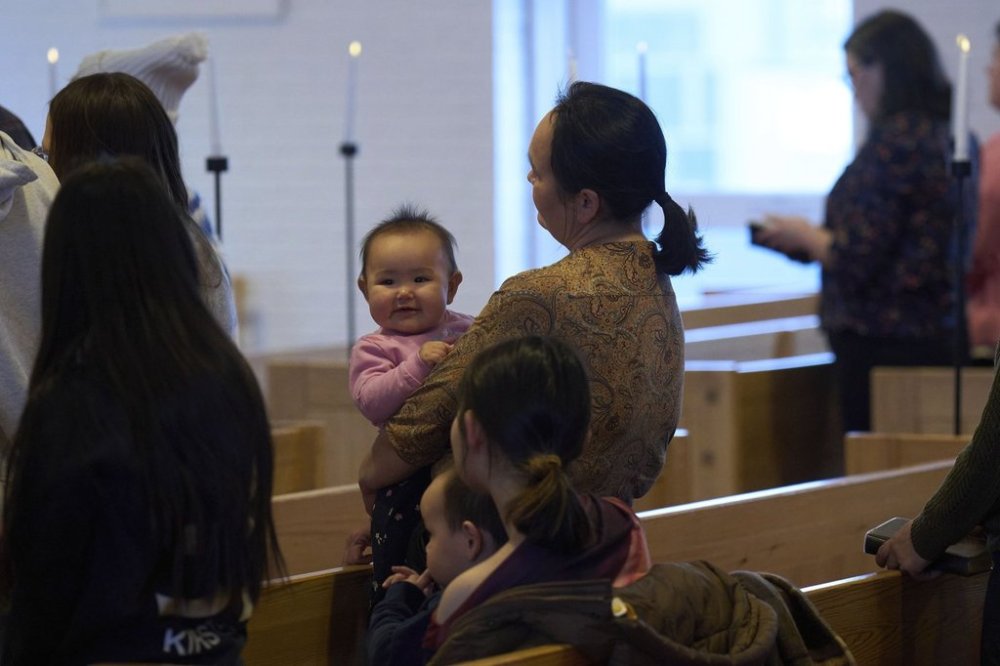
Greenland is huge — about three times the size of Texas; most of it covered in ice. Still, its 17 parishes are located across many settlements in the icy land and people endure the frigid Arctic climate to fill up church pews on Sundays.
Some even tune in to radio-transmitted services on their phones on a break from fishing and hunting for seals, whales and polar bears, as their ancestors have done for generations.
That rugged yet vulnerable lifestyle helps fuel people’s devotion, said Bishop Paneeraq Siegstad Munk, leader of Greenland’s Evangelical Lutheran Church.
Greenlanders don’t have to believe to belong to the Lutheran Church
Religiosity levels vary in Greenland as it does elsewhere. Sometimes being a member of the Lutheran Church here doesn’t mean one believes fully — or at all — in the church’s teachings, or even the presence of God.
Recently, Salik Schmidt, 35, and Malu Schmidt, 33, celebrated their wedding with family members, at Church of Our Savior. Built in 1849, it is known as the Nuuk Cathedral.
Malu is spiritual but not religious; Salik is an atheist. Both said they’ll proudly belong to the Lutheran Church for life.
“Traditions are important to me because they pass on from my grandparents to my parents, and it’s been my way of honoring them,” Malu said.
It also provides a sense of safety and permanence among change, Salik said.
The complicated history of Nuuk’s Lutheran founder
There are two Lutheran churches in Nuuk. The Hans Egede Church is named for the Danish-Norwegian missionary who came to Greenland in 1721 with the aim of spreading Christianity, and who founded the capital city seven years later.
A short distance away stands the cathedral, and next to it, a statue of Egede remains on a hill in the Old District. In recent years, the statue was vandalized, doused with red paint and marked with the word “decolonize.”
Egede’s legacy is divisive. Some credit him for helping educate the local population and spreading Lutheranism, which continues to unite many Greenlanders under rituals and tradition.
But for some, Egede symbolizes the arrival of colonialism and the suppression of rich Inuit traditions and culture by Lutheran missionaries and Denmark’s rule.
Independence, Trump and the upcoming election
Greenland is now a semi-autonomous territory of Denmark, and Greenlanders are increasingly in favor of getting full independence — a crucial issue in the election on March 11.
Some say Greenland’s independence movement has received a boost after Trump pushed their Arctic homeland into the spotlight by threatening to take it over.
At a time of uncertainty, “it’s important for us to have faith,” said the Rev. John Johansen after a service at the Hans Egede Church, where an American couple visiting Greenland attended wearing pins that read: “I didn’t vote for him.”
The tension of shared Lutheran and Inuit traditions
The Church of Greenland separated from Denmark’s Evangelical Lutheran Church in 2009 and is funded by Greenland’s government. Although the Lutheran Church comes from Denmark, the leader of the church in Greenland is proud that it remains uniquely Greenlandic.
In recent years, young people have increasingly demanded the revival of pre-Christian shamanistic traditions like drum dancing; some have been getting Inuit tattoos to proudly reclaim their ancestral roots. For some, it’s a way to publicly and permanently reject the legacy of Danish colonialism and European influence.
Still, the Lutheran Church remains for many an important part of the national identity.
Greenland was a colony under Denmark’s crown until 1953, when it became a province in the Scandinavian country. In 1979, the island was granted home rule, and 30 years later Greenland became a self-governing entity. But Denmark retains control over foreign and defense affairs.
Until 1953, no other denominations were allowed to register and work in Greenland other than the Lutheran Church, said Gimmi Olsen, an assistant professor in the theology department at the University of Greenland.

Since then, Pentecostal and Catholic churches — mostly serving immigrants from the Philippines — have settled in Greenland. Other Christians include Baptists and Jehovah’s Witnesses.
___
Associated Press journalist Emilio Morenatti contributed to this report.
___
Associated Press religion coverage receives support through the AP’s collaboration with The Conversation US, with funding from Lilly Endowment Inc. The AP is solely responsible for this content.
The Free Press acknowledges the financial support it receives from members of the city’s faith community, which makes our coverage of religion possible.