Norad, Haiti, critical minerals expected to top Trudeau-Biden talking points
Advertisement
Read this article for free:
or
Already have an account? Log in here »
To continue reading, please subscribe:

Digital Subscription
One year of digital access for only $205*
- Enjoy unlimited reading on winnipegfreepress.com
- Read the E-Edition, our digital replica newspaper
- Access News Break, our award-winning app
- Play interactive puzzles
*First annual payment billed as $205.00 + GST for one year. This annual subscription will automatically renew at $233.00 + GST every 52 weeks (10% off the regular annual price of $259.35). Offer available to new and qualified returning subscribers only. Cancel any time.
To continue reading, please subscribe:
Add Free Press access to your Brandon Sun subscription for only an additional
$1 for the first 4 weeks*
- Enjoy unlimited reading on winnipegfreepress.com
- Read the E-Edition, our digital replica newspaper
- Access News Break, our award-winning app
- Play interactive puzzles
*Your next Brandon Sun subscription payment will increase by $1.00 and you will be charged $17.95 plus GST for four weeks. After four weeks, your payment will increase to $24.95 plus GST every four weeks.
Read unlimited articles for free today:
or
Already have an account? Log in here »
Hey there, time traveller!
This article was published 19/03/2023 (1290 days ago), so information in it may no longer be current.
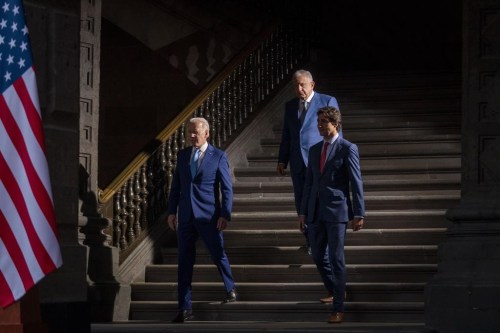
WASHINGTON – U.S. President Joe Biden will spend two days in Canada beginning Thursday to meet with Prime Minister Justin Trudeau and speak to a joint session of Parliament, his first visit north of the border since taking the oath of office in 2021.
Visits to Canada have historically been a popular first foreign trip for new presidents — Jimmy Carter and Donald Trump being the rare exceptions — but COVID-19 intervened twice in the years since Biden’s inauguration to prevent one from happening.
Here are some of the issues the two leaders are likely to discuss.

Modernizing Norad: Until last month, the binational early-warning system known as the North American Aerospace Defence Command might have been best known for tracking Santa Claus on Christmas Eve. But a February flurry of unidentified flying objects drifting through North American airspace, most notably what U.S. officials insist was a Chinese surveillance balloon, exposed what Norad commander Gen. Glen VanHerck described as a “domain awareness gap”: the archaic, Cold War-era system’s ability to track small, high-flying, slow-moving objects. Coupled with the brazen ambitions of Russian President Vladimir Putin, the ongoing but largely opaque joint effort to upgrade Norad — rarely mentioned in past Trudeau-Biden readouts — is suddenly front and centre for both governments.
Helping Haiti: The list of foreign-policy hotspots around the world that instantly bring Canada to mind is a short one, but Haiti is surely near the top. And as Haiti has descended ever deeper into lawlessness in the wake of the 2021 assassination of president Jovenel Moïse, the need for military intervention has been growing — and some senior U.S. officials have expressly name-checked Canada as the perfect country to lead the effort. Trudeau’s response has been diplomatic but firm: the crisis is best addressed from a distance. “Canada is elbows deep in terms of trying to help,” he said last month. “But we know from difficult experience that the best thing we can do to help is enable the Haitian leadership … to be driving their pathway out of this crisis.”
Mission-Critical-Minerals: No high-level conversation between the U.S. and Canada these days would be complete without talking about critical minerals, the 21st-century rocket fuel for the electric-vehicle revolution that Trudeau calls the “building blocks for the clean economy.” Canada has the minerals — cobalt, lithium, magnesium and rare earth elements, among others — and a strategy to develop them, but the industry is still in its infancy and the U.S. wants those minerals now. The issue has profound foreign-policy implications: China has long dominated the critical minerals supply chain, something the Biden administration is determined to change. “This really is one of the most transformative moments since the Industrial Revolution,” said Helaina Matza, the State Department’s deputy special co-ordinator for the G7’s Partnership for Global Infrastructure and Investment. “We understand that we can’t do it alone.”
Water, water everywhere: Canada and the U.S. have been negotiating since 2018 to modernize the Columbia River Treaty, a 1961 agreement designed to protect a key cross-border watershed the size of Texas in the Pacific Northwest. Despite 15 separate rounds of talks, progress has been middling at best. Meanwhile, Canada is under U.S. pressure to allow the International Joint Commission — the investigative arm of a separate 1909 boundary waters agreement — to investigate toxic mining runoff in the B.C. Interior that Indigenous communities on both sides of the border say has been poisoning their lands and waters for years. Add to all of that the mounting pressure on Canada to supercharge efforts to extract and process critical minerals, and the plot promises to thicken.
Border blues: For what is probably the first time in two decades, Capitol Hill lawmakers are talking about a need to shore up American security along the Canada-U.S. border. That’s because there’s been an increase in the number of undocumented migrants entering the country via Canada — and immigration hysteria is a popular political cudgel with Republicans. But Canada has more reason to be concerned: northbound irregular migration has become enough of a problem that Prime Minister Justin Trudeau has publicly suggested renegotiating the Safe Third Country Agreement, the 2004 bilateral treaty that creates a loophole for would-be asylum seekers who can successfully sneak into either country. The U.S., however, is widely seen as having little appetite for doing so. It perhaps hasn’t helped matters that Canada has imposed new tax measures to discourage foreigners from owning real estate north of the border; some on Capitol Hill are pressing the Biden administration to demand an exemption.

A trade deal by any other name: Regardless of what the two leaders end up talking about, it will happen within the framework of the U.S.-Mexico-Canada Agreement, known in Canada as CUSMA. The USMCA era of continental trade, which began in earnest in 2020, has not been without its hiccups, including disputes over U.S. access to Canada’s dairy market and the way the U.S. defines foreign automotive content. The Biden administration is also staunchly opposed to Canada’s plans for a digital services tax, which it considers a violation. The agreement is due to be reviewed in 2026, and a lot could happen — especially on Capitol Hill and in the White House — between now and then. It’s also worth noting that while it’s not covered by the trade deal, the softwood lumber dispute remains a perennial irritant. International Trade Minister Mary Ng met last week with industry leaders to discuss “unwarranted and illegal U.S. duties” on softwood lumber, vowing that a solution that protects Canadian jobs “is the only resolution that we will accept.”
This report by The Canadian Press was first published March 19, 2023.