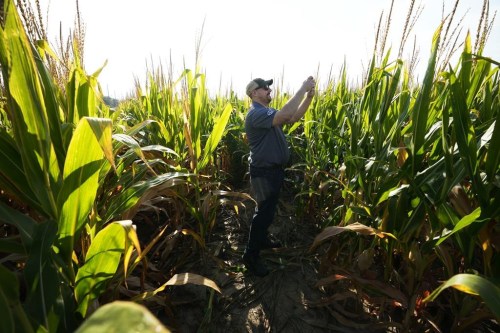
‘Short corn’ could replace the towering cornfields steamrolled by a changing climate
Advertisement
Read this article for free:
or
Already have an account? Log in here »
To continue reading, please subscribe:

Digital Subscription
One year of digital access for only $205*
- Enjoy unlimited reading on winnipegfreepress.com
- Read the E-Edition, our digital replica newspaper
- Access News Break, our award-winning app
- Play interactive puzzles
*First annual payment billed as $205.00 + GST for one year. This annual subscription will automatically renew at $233.00 + GST every 52 weeks (10% off the regular annual price of $259.35). Offer available to new and qualified returning subscribers only. Cancel any time.
To continue reading, please subscribe:
Add Free Press access to your Brandon Sun subscription for only an additional
$1 for the first 4 weeks*
- Enjoy unlimited reading on winnipegfreepress.com
- Read the E-Edition, our digital replica newspaper
- Access News Break, our award-winning app
- Play interactive puzzles
*Your next Brandon Sun subscription payment will increase by $1.00 and you will be charged $17.95 plus GST for four weeks. After four weeks, your payment will increase to $24.95 plus GST every four weeks.
Read unlimited articles for free today:
or
Already have an account? Log in here »
Hey there, time traveller!
This article was published 23/09/2024 (725 days ago), so information in it may no longer be current.
WYOMING, Iowa (AP) — Taking a late-summer country drive in the Midwest means venturing into the corn zone, snaking between 12-foot-tall green, leafy walls that seem to block out nearly everything other than the sun and an occasional water tower.
The skyscraper-like corn is a part of rural America as much as cavernous red barns and placid cows.
But soon, that towering corn might become a miniature of its former self, replaced by stalks only half as tall as the green giants that have dominated fields for so long.
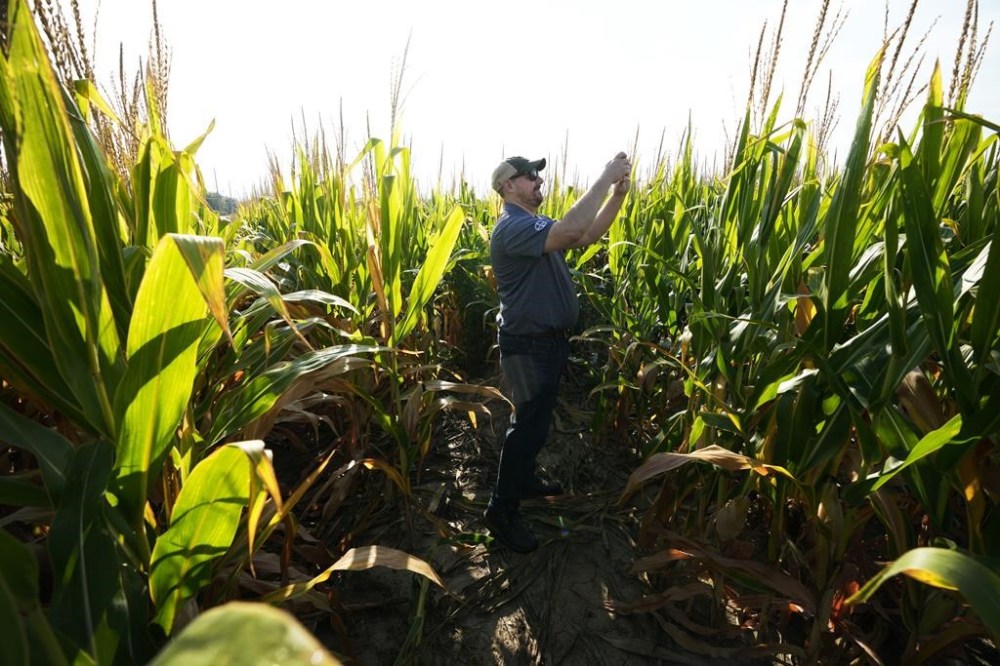
“As you drive across the Midwest, maybe in the next seven, eight, 10 years, you’re going to see a lot of this out there,” said Cameron Sorgenfrey, an eastern Iowa farmer who has been growing newly developed short corn for several years, sometimes prompting puzzled looks from neighboring farmers. “I think this is going to change agriculture in the Midwest.”
The short corn developed by Bayer Crop Science is being tested on about 30,000 acres (12,141 hectares) in the Midwest with the promise of offering farmers a variety that can withstand powerful windstorms that could become more frequent due to climate change. The corn’s smaller stature and sturdier base enable it to withstand winds of up to 50 mph — researchers hover over fields with a helicopter to see how the plants handle the wind.
The smaller plants also let farmers plant at greater density, so they can grow more corn on the same amount of land, increasing their profits. That is especially helpful as farmers have endured several years of low prices that are forecast to continue.
The smaller stalks could also lead to less water use at a time of growing drought concerns.
U.S. farmers grow corn on about 90 million acres (36 million hectares) each year, usually making it the nation’s largest crop, so it’s hard to overstate the importance of a potential large-scale shift to smaller-stature corn, said Dior Kelley, an assistant professor at Iowa State University who is researching different paths for growing shorter corn. Last year, U.S. farmers grew more than 400 million tons (363 million metric tonnes) of corn, most of which was used for animal feed, the fuel additive ethanol, or exported to other countries.
“It is huge. It’s a big, fundamental shift,” Kelley said.
Researchers have long focused on developing plants that could grow the most corn but recently there has been equal emphasis on other traits, such as making the plant more drought-tolerant or able to withstand high temperatures. Although there already were efforts to grow shorter corn, the demand for innovations by private companies such as Bayer and academic scientists soared after an intense windstorm — called a derecho — plowed through the Midwest in August 2020.
The storm killed four people and caused $11 billion in damage, with the greatest destruction in a wide strip of eastern Iowa, where winds exceeded 100 mph. In cities such as Cedar Rapids, the wind toppled thousands of trees but the damage to a corn crop only weeks from harvest was especially stunning.
“It looked like someone had come through with a machete and cut all of our corn down,” Kelley said.
Or as Sorgenfrey, the Iowa farmer who endured the derecho put it, “Most of my corn looked like it had been steamrolled.”
Although Kelley is excited about the potential of short corn, she said farmers need to be aware that cobs that grow closer to the soil could be more vulnerable to diseases or mold. Short plants also could be susceptible to a problem called lodging, when the corn tilts over after something like a heavy rain and then grows along the ground, Kelley said.
Brian Leake, a Bayer spokesman, said the company has been developing short corn for more than 20 years. Other companies such as Stine Seed and Corteva also have been working for a decade or longer to offer short-corn varieties.
While the big goal has been developing corn that can withstand high winds, researchers also note that a shorter stalk makes it easier for farmers to get into fields with equipment for tasks such as spreading fungicide or seeding the ground with a future cover crop.
Bayer expects to ramp up its production in 2027, and Leake said he hopes that by later in this decade, farmers will be growing short corn everywhere.
“We see the opportunity of this being the new normal across both the U.S. and other parts of the world,” he said.
___
This story was first published on Sept. 23, 2024. It was updated Sept. 24, 2024, to correct the amount of corn that U.S. farmers grew last year. They grew more than 400 million tons (363 million metric tonnes), not 400 tons (363 metric tonnes) of corn.