Quebec lifts capacity limits in bars and restaurants — but dancing still banned

Advertisement

Advertise with us

MONTREAL - As Quebec lifted capacity restrictions in bars and restaurants on Monday, owners were hoping to regain more of the business lost when the limits were imposed more than a year ago to curb the spread of COVID-19.

Read this article for free:


or

Already have an account? Log in here »

To continue reading, please subscribe:

Subscribe and receive a limited-edition Free Press branded hat or tote.

Digital Subscription

One year of digital access for only $205*

  • Enjoy unlimited reading on winnipegfreepress.com
  • Read the E-Edition, our digital replica newspaper
  • Access News Break, our award-winning app
  • Play interactive puzzles

*First annual payment billed as $205.00 + GST for one year. This annual subscription will automatically renew at $233.00 + GST every 52 weeks (10% off the regular annual price of $259.35). Offer available to new and qualified returning subscribers only. Cancel any time.

To continue reading, please subscribe:

Add Free Press access to your Brandon Sun subscription for only an additional

$1 for the first 4 weeks*

  • Enjoy unlimited reading on winnipegfreepress.com
  • Read the E-Edition, our digital replica newspaper
  • Access News Break, our award-winning app
  • Play interactive puzzles
Start now

*Your next Brandon Sun subscription payment will increase by $1.00 and you will be charged $17.95 plus GST for four weeks. After four weeks, your payment will increase to $24.95 plus GST every four weeks.

Hey there, time traveller!
This article was published 01/11/2021 (1783 days ago), so information in it may no longer be current.

MONTREAL – As Quebec lifted capacity restrictions in bars and restaurants on Monday, owners were hoping to regain more of the business lost when the limits were imposed more than a year ago to curb the spread of COVID-19.

Renaud Poulin, president of the Corporation of owners of bars, brasseries and taverns, said while it’s not a return to the pre-pandemic normal, it’s good news.

“For our members, it’s welcome, because it’ll allow them to increase capacity and get back the business that comes with normal operating hours,” said Poulin, who is also owner of Resto Bar La Chope in Châteauguay, Que., south of Montreal.
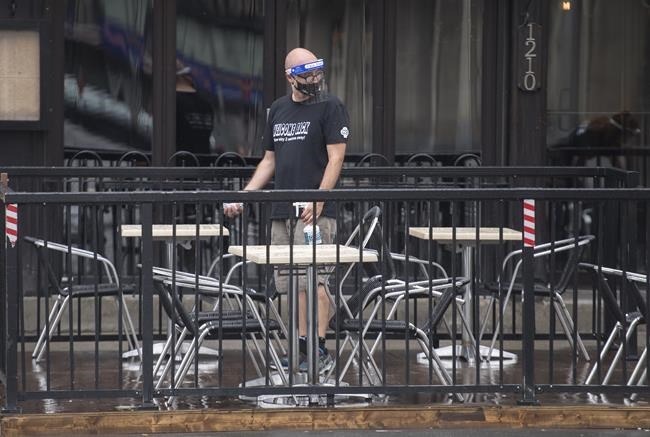
A man wears protective gear as he cleans the outdoor terrace of a pub in Montreal on July 11, 2020. THE CANADIAN PRESS/Graham Hughes

It’s hoped that it might be easier to attract employees as opening hours return to normal, Poulin said. “Many businesses made their money from 11 p.m. to 3 a.m.,” he said. The 1 a.m. last call that had been in place cut into earnings for staff, and there was less interest in filling shifts, he added: “More hours means employees will benefit too, so we’re sensing more staff will want to come back.”

Establishments that serve alcohol are now allowed to stay open until 3 a.m. — the closing time that was in place before the pandemic — and the required distance between tables has dropped from two metres to one metre.

Reservations are no longer limited to 25 people, but each table can still only seat a maximum of ten people or groups from no more than three different households. Dancing and singing inside bars and restaurants remain prohibited across the province, and patrons must show proof of vaccination before they can enter.

Restaurant owners believe it’s finally their turn to reap the benefits of easing restrictions after seeing dining rooms closed in some cities, including Montreal, for eight months at the height of the pandemic and surviving on financial aid or loans, an association spokesperson said.

“We need those sales. Restaurant owners in Montreal were closed for eight months between October 2020 and June 2021 and have taken some loans to be able to tough (it out),” said Martin Vézina of the Quebec Restaurant Association.

Vézina said his group’s discussions with the Quebec government have given hope that the restrictions being lifted this week won’t be coming back. His organization said approximately 15 per cent of the province’s restaurants shut down permanently during the pandemic, and others may follow as federal aid programs wind down.

Ziggy Eichenbaum, owner of Ziggy’s Pub on Crescent Street in downtown Montreal, said he would have closed without rent assistance. He said welcoming patrons until 3 a.m. will be good for the bottom line, even with protocols in place.

“We’re going to find out tonight, but it’s looking good,” said Eichenbaum. “It represents a hell of a lot, a lot of people would go home with last call at 1 a.m., at least now, we get a second group of people coming in for a nightcap.”

Still, the co-owner of Montreal’s Burgundy Lion pub would like to see restrictions eased further.

“No singing, no dancing, no getting up, no mingling. I still think is such a major issue,” said Paul Desbaillets, co-owner of the Burgundy Lion Group. “It’s really putting a damper on the idea that we could be singing to the high heavens about this new look normalcy.”

While you can’t dance in a Quebec nightclub, you can cheer and drink in a packed arena or stadium.

“Nobody can understand what is the difference: remember, any of the establishments we’re discussing, you’ve only gotten in if you have the (vaccine) passport,” Desbaillets said.

Meanwhile, health authorities reported 497 new COVID-19 cases Monday and two more deaths attributed to the novel coronavirus. Hospitalizations rose by eight, to 244, after 19 people entered hospital and 11 were discharged. Sixty-seven people were listed in intensive care, a rise of five from the prior day.

The Health Department said 3,241 vaccine doses were administered in the previous 24 hours, and Quebec’s public health institute said 87.9 per cent of residents 12 and older are considered adequately vaccinated.

Quebec has 4,415 active reported cases of COVID-19.

This report by The Canadian Press was first published Nov. 1, 2021.
Report Error Submit a Tip

More Stories

Siloam Mission, WFPS discussing on-site paramedic to reduce staggering number of emergency calls

Scott Billeck 4 minute read Preview

Siloam Mission, WFPS discussing on-site paramedic to reduce staggering number of emergency calls

Scott Billeck 4 minute read Yesterday at 2:00 AM CDT

Winnipeg’s fire-paramedic service and its largest homeless-serving organization are discussing what it would look like to station at least one paramedic at Siloam Mission, as emergency calls to the downtown facility surge.

The ongoing discussions come as Winnipeg Fire Paramedic Service crews were dispatched 1,771 times during the first eight months of the year to the two adjacent Siloam properties at 303 Stanley St. and 300 Princess St.

WFPS said most of the calls were related to overdoses or other consequences of substance use, with the total nearly double the 854 calls recorded over the same period last year. By comparison, there were 831 calls during the same span in 2024, and 591 in 2023.

“The number of emergency calls isn’t sustainable for us as a service, but it’s certainly not sustainable for them as an agency trying to provide services,” WFPS chief Ryan Sneath told the Free Press. “And they recognize that they’re impacting emergency services, not them specifically, but the site in a significant way.”

Read
Yesterday at 2:00 AM CDT

Canada must not accept another Iranian autocracy

David Matas 5 minute read 2:01 AM CDT

Iran is a state run by a radical government victimizing its citizens and its neighbours. How do we change that? Any regime change that repeats the mistakes of the past is not a solution.

What went wrong in the past which led to the current regime? One answer is the U.K. and American aided coup which led to the ouster in 1953 of a democratically elected government headed at the time by Mohammad Mossadegh and its replacement with an American friendly autocrat, the Shah of Iran, Mohammad Reza Pahlavi.

The Shah imposed his rule through the Iranian National Intelligence and Security Organization — SAVAK, the acronym of its Persian name. SAVAK systematically inflicted torture, arbitrary killings and extra-judicial killings on perceived opponents of the regime. It was only a matter of time before repression of a regime directed to serving foreign interests would be overthrown.

What replaced the regime of the Shah, in 1979, the current regime of the mullahs, is a regime as intolerant and violent as the regime of the Shah and then some. That was not inevitable. But neither was it surprising. The vicious nature of the current regime, following the example set by the Shah, and its hatred for the United States, reacting to the U.S. aided imposition of the Shah, both echoes and reacts to the past. In 1979, the U.S. reaped what it sowed in 1953.

Canada-U.S. trade relationship is broken, but the damage can — and will — be repaired

Tom Brodbeck 5 minute read Preview

Canada-U.S. trade relationship is broken, but the damage can — and will — be repaired

Tom Brodbeck 5 minute read Thursday, Sep. 17, 2026

Canada needs to get serious about diversifying its trade beyond the United States. But at the same time, Canadians should expect relations with the U.S. to normalize after Donald Trump is no longer in the White House.

For generations, Canada-U.S. trade was considered almost a fact of geography. The two countries share the world’s longest undefended border, deeply integrated supply chains and a century of commercial relationships.

Canadian manufacturers depend on American customers. American manufacturers depend on Canadian suppliers. Energy, agriculture, automotive production and countless other industries operate across the border as though it barely exists.

That isn’t going to change dramatically, even in the midst of a bitter trade war unleashed by the U.S. president.

Read
Thursday, Sep. 17, 2026

American Hostage stars recall warmth of Winnipeggers during brutal winter

Randall King 7 minute read Preview

American Hostage stars recall warmth of Winnipeggers during brutal winter

Randall King 7 minute read Yesterday at 6:13 PM CDT

TORONTO — When you stream the eight-part series American Hostage, a sense of familiarity may strike.

That’s because the show was shot in Winnipeg — especially in the Exchange District — from November of last year to the beginning of February, with Winnipeg portraying Indianapolis circa 1977.

The whole world seemed to be watching that midwest American city that year as a hostage crisis unfolded involving one Tony Kiritsis, an angry man who goes ballistic when a mortgage brokerage was poised to foreclose on property he had dreamed of developing into a shopping centre.

Kiritsis kidnapped his mortgage broker, Richard Hall, wiring a shotgun to the back of his head, and demanded a public airing of his grievances, with the reluctant help of popular radio broadcaster Fred Heckman.

Read
Yesterday at 6:13 PM CDT

Manitoba abandoning spring, fall clock changes

Carol Sanders 8 minute read Preview

Manitoba abandoning spring, fall clock changes

Carol Sanders 8 minute read Updated: Yesterday at 8:48 AM CDT

Time’s up for the time change in Manitoba.

Manitobans won’t be setting their clocks back an hour in November. The province has decided to permanently stay on daylight time after surveying residents on the twice annual clock adjustment.

“We heard from Manitobans loud and clear — no more changing the clocks in Manitoba,” Premier Wab Kinew said in a news release Thursday.

Most of the 72,000 votes submitted in an online EngageMB survey — 92 per cent — said they would like to see the practice end. The survey asked if they preferred earlier sunrises in winter with standard time or the later sunsets in summer with daylight time. More than half of survey participants (58 per cent) indicated a preference to stay on permanent daylight time; 34 per cent voted to eliminate the time change but stay on standard time.

Read
Updated: Yesterday at 8:48 AM CDT

A life’s story: activist, educator, organizer knew the true meaning of community

Janine LeGal 7 minute read Preview

A life’s story: activist, educator, organizer knew the true meaning of community

Janine LeGal 7 minute read 3:00 AM CDT

Somewhere between a love for sharing stories and a love of community connections, Michael (Mike) Maunder lived his life. Giving voice to people and neighbourhoods was a passion for the natural-born community organizer.

An author, teacher and principal, Maunder lived in a one-bedroom apartment in West Broadway and devoted himself to community development, education and neighbourhood renewal.

He maintained a connection with Augustine United Church, whose commitment to social justice he appreciated, volunteered at the Sandy-Saulteaux Spiritual Centre, and found comfort in a Buddhist prayer community.

Maunder died on July 15 at the age of 80.

Read
3:00 AM CDT