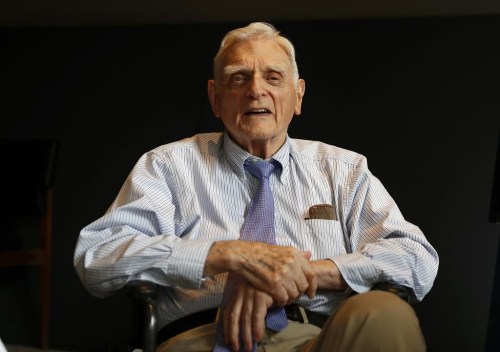
John Goodenough, a Nobel Prize-winning co-creator of the revolutionary lithium battery, dies at 100

Advertisement

Advertise with us

AUSTIN, Texas (AP) — John Goodenough, who shared the 2019 Nobel Prize in chemistry for his work developing the lithium-ion battery that transformed technology with rechargeable power for devices ranging from cellphones, computers, and pacemakers to electric cars, has died at 100, the University of Texas announced Monday.

Read this article for free:


or

Already have an account? Log in here »

To continue reading, please subscribe:

Subscribe and receive a limited-edition Free Press branded hat or tote.

Digital Subscription

One year of digital access for only $205*

  • Enjoy unlimited reading on winnipegfreepress.com
  • Read the E-Edition, our digital replica newspaper
  • Access News Break, our award-winning app
  • Play interactive puzzles

*First annual payment billed as $205.00 + GST for one year. This annual subscription will automatically renew at $233.00 + GST every 52 weeks (10% off the regular annual price of $259.35). Offer available to new and qualified returning subscribers only. Cancel any time.

To continue reading, please subscribe:

Add Free Press access to your Brandon Sun subscription for only an additional

$1 for the first 4 weeks*

  • Enjoy unlimited reading on winnipegfreepress.com
  • Read the E-Edition, our digital replica newspaper
  • Access News Break, our award-winning app
  • Play interactive puzzles
Start now

*Your next Brandon Sun subscription payment will increase by $1.00 and you will be charged $17.95 plus GST for four weeks. After four weeks, your payment will increase to $24.95 plus GST every four weeks.

Hey there, time traveller!
This article was published 26/06/2023 (1196 days ago), so information in it may no longer be current.

AUSTIN, Texas (AP) — John Goodenough, who shared the 2019 Nobel Prize in chemistry for his work developing the lithium-ion battery that transformed technology with rechargeable power for devices ranging from cellphones, computers, and pacemakers to electric cars, has died at 100, the University of Texas announced Monday.

Goodenough died Sunday at an assisted living facility in Austin, the university announced. No cause of death was given. Goodenough was a faculty member at Texas for nearly 40 years.

Goodenough was the oldest person to receive a Nobel Prize when he shared the award with British-born American scientist M. Stanley Whittingham and Japan’s Akira Yoshino.
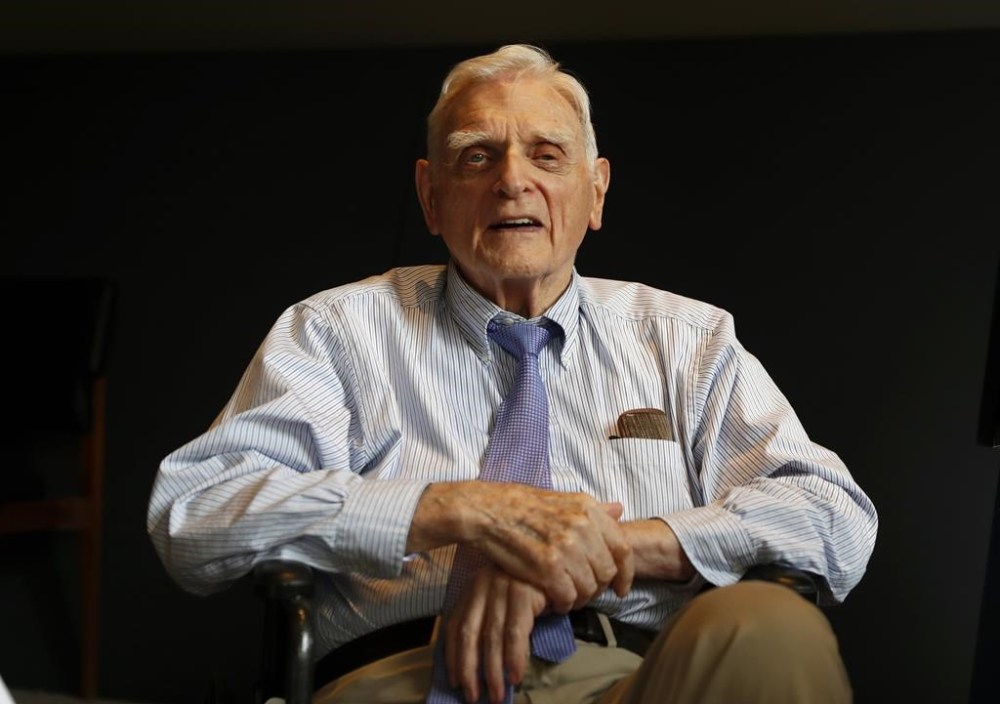
FILE - Nobel chemistry winner John B. Goodenough poses for the media at the Royal Society in London, Wednesday, Oct. 9, 2019. Goodenough, who shared the 2019 Nobel Prize in chemistry for his work helping develop the lithium-ion battery, transforming technology with rechargeable power for devices ranging from cellphones, computers, and pacemakers to electric cars, died Sunday, June 25, 2023,, the University of Texas announced Monday, June 26. He was 100. Goodenough was a faculty member at Texas for nearly 40 years. (AP Photo/Alastair Grant, File)

“Live to 97 and you can do anything,” Goodenough said when the Nobel was awarded, adding he was grateful he wasn’t forced to retire at 65.

And while his name may not ring a bell to most, Goodenough’s research helped unlock a revolution in technology now taken for granted in today’s world of portable phones, tablets and just about anything else with a plug-in port for a recharge.

Lithium-ion batteries were the first truly portable and rechargeable batteries, and they took more than a decade to develop. Whittingham said in 2019 that he had no inkling that his work decades ago would have such a profound impact on the world.

“We thought it would be nice and help in a few things,” Goodenough said, “but never dreamed it would revolutionize electronics and everything else.”

Goodenough, Whittingham and Yoshino each had unique breakthroughs that laid the foundation for developing a commercial rechargeable battery and the three shared the $900,000 Nobel Prize.

Whittingham’s work in the 1970s harnessed the tendency of lithium — the lightest metal — to give away its electrons to make a battery capable of generating just over two volts.

By 1980, Goodenough had built on Whittingham’s work and doubled the battery’s capacity to four volts by using cobalt oxide in the cathode, one of the two electrodes that make up the ends of a battery.
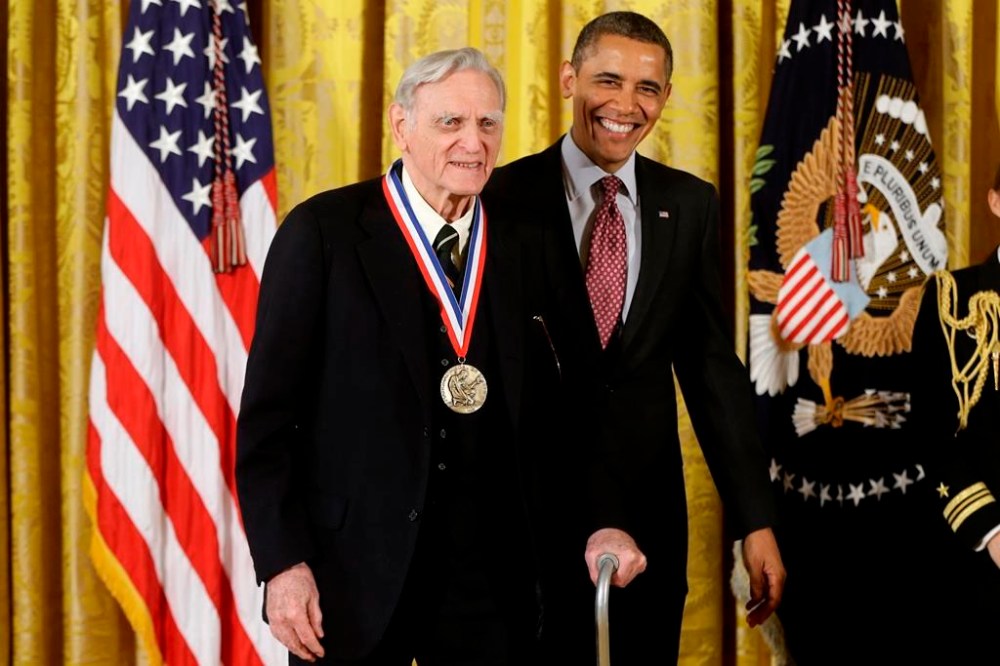
FILE - In this Feb. 1, 2013 file photo, President Barack Obama awards the National Medal of Science to Dr. John Goodenough, of the University of Texas, during a ceremony in the East Room of the White House in Washington. Goodenough, who shared the 2019 Nobel Prize in chemistry for his work helping develop the lithium-ion battery, transforming technology with rechargeable power for devices ranging from cellphones, computers, and pacemakers to electric cars, died Sunday, June 25, 2023,, the University of Texas announced Monday, June 26. He was 100. Goodenough was a faculty member at Texas for nearly 40 years. (AP Photo/Charles Dharapak, File)

That battery remained too explosive for general commercial use. Yoshino’s work in the 1980s eliminated the volatile pure lithium from the battery and instead opted for lithium ions that are safer. The first lightweight, safe, durable and rechargeable commercial batteries entered the market in 1991.

Born in Jena, Germany in 1922, Goodenough grew up in the United States and earned a Ph.D. in chemistry from the University of Chicago. He began his career at the Massachusetts Institute of Technology, where his research laid the groundwork for development of random-access memory for the digital computer.

Goodenough was head of the Inorganic Chemistry Laboratory at the University of Oxford in England when he made his lithium-ion discovery. He joined the Texas faculty in 1986, and was still teaching and researching battery materials and solid-state science and engineering problems when he won the Nobel Prize.

Goodenough and his wife Irene were married 70 years until her death in 2016.
Report Error Submit a Tip

More Stories

Broadening prediction-market gambling a bad idea

Editorial 4 minute read Preview

Broadening prediction-market gambling a bad idea

Editorial 4 minute read Yesterday at 2:01 AM CDT

Let’s make a prediction: sooner or later, when Canadian governments find a way to take their own cut of the action, prediction-contract gambling on everything from sports to entertainment to political decisions is going to come to Canada.

And that’s a horrible, dangerous, pernicious idea.

Unless you have particular access to information — either inside information or strategic information based on skills or education — you’re not likely to make money at it. In fact, structurally, you’re likely to lose. In prediction markets, you basically pay an amount, plus fees from the company involved, to bet on whether something will or will not happen within a certain time frame. The amount you pay for your contract depends on how other people are also betting.

As Wealthsimple describes it, “You buy whichever side you think is right. Prices move with demand, so if the market leans towards one outcome, the more that side costs. If a lot of people are backing the TSX to finish above 38,000, yes gets more expensive and no gets cheaper.”

Read
Yesterday at 2:01 AM CDT

John Goodenough, a Nobel Prize-winning co-creator of the revolutionary lithium battery, dies at 100

Jim Vertuno, The Associated Press 4 minute read Preview

John Goodenough, a Nobel Prize-winning co-creator of the revolutionary lithium battery, dies at 100

Jim Vertuno, The Associated Press 4 minute read Monday, Jun. 26, 2023

AUSTIN, Texas (AP) — John Goodenough, who shared the 2019 Nobel Prize in chemistry for his work developing the lithium-ion battery that transformed technology with rechargeable power for devices ranging from cellphones, computers, and pacemakers to electric cars, has died at 100, the University of Texas announced Monday.

Goodenough died Sunday at an assisted living facility in Austin, the university announced. No cause of death was given. Goodenough was a faculty member at Texas for nearly 40 years.

Goodenough was the oldest person to receive a Nobel Prize when he shared the award with British-born American scientist M. Stanley Whittingham and Japan's Akira Yoshino.

“Live to 97 and you can do anything,” Goodenough said when the Nobel was awarded, adding he was grateful he wasn't forced to retire at 65.

Read
Monday, Jun. 26, 2023

News briefs for Sunday, October 4, 2026

1 minute read Updated: 12:13 PM CDT

A collection of breaking news briefs filed on Sunday, October 4, 2026

Fentanyl, crack seized in traffic stop

12:13 PM

Winnipeg police seized fentanyl and arrested three people after pulling over a vehicle with a smashed windshield in the city's north end Friday.

Today’s horoscope

Georgia Nicols 4 minute read Preview

Today’s horoscope

Georgia Nicols 4 minute read 2:00 AM CDT

MOON ALERT: Caution! Avoid shopping (except food and gas) and important decisions until after 6:30 p.m. today. After that, the moon moves from Cancer into Leo.

ARIES (March 21-April 19)

Don’t expect much co-operation from partners, spouses and close friends. This is why you might feel cut off from others or a bit lonely. There’s the sense a gulf exists between you and everyone else. But this is temporary. Courage!

TAURUS (April 20-May 20)

Read
2:00 AM CDT

Manitoba’s own Summer Howell takes on biggest role yet as Stephen King’s telekinetic teen Carrie

Randall King 7 minute read Preview

Manitoba’s own Summer Howell takes on biggest role yet as Stephen King’s telekinetic teen Carrie

Randall King 7 minute read Friday, Oct. 2, 2026

From the tender age of eight, actress Summer Howell has made her presence known in a series of horror films shot in her home province of Manitoba.

Her first film was Curse of Chucky (2013), director Don Mancini’s continuation of the venerable killer doll series he started (as a screenwriter) in 1988 with Child’s Play.

“Even then, it was obvious she was very talented, intelligent and delightful,” Mancini said of Howell.

Though she has worked in other genres, Howell gravitated to horror repeatedly, with credits in Shawn Linden’s harrowing Hunter Hunter (2020) and the 2023 possession thriller All Fun and Games. Earlier this year, she shot the horror film Sundown in Winnipeg with director Rebekah McKendry, which premièred last week at Beyond Fest in Los Angeles and is headed for a streaming berth on Shudder.

Read
Friday, Oct. 2, 2026

Blown lead spoils Jets opener

Mike McIntyre 7 minute read Preview

Blown lead spoils Jets opener

Mike McIntyre 7 minute read Friday, Oct. 2, 2026

Younger. Faster. Stronger.

They may still be a long ways from a finished product, but it’s safe to say the new-look Winnipeg Jets made a mostly favourable first impression on Friday night in front of a sold-out crowd at Canada Life Centre.

Sure, a 4-3 overtime loss to a hard-nosed Boston Bruins outfit is going to sting a little, especially since the home team was just 98 seconds away from a regulation victory.

But if the Jets can bottle up this kind of energy and effort, they should enjoy plenty of success over the course of the 84-game campaign.

Read
Friday, Oct. 2, 2026