Lawsuit says Anthropic, OpenAI, SpaceXAI and Google made illegal agreement on AI slowdown

Advertisement

Advertise with us

A new lawsuit claims Anthropic, OpenAI, SpaceXAI and Google made an illegal deal to slow the pace of their respective AI development.

Read this article for free:


or

Already have an account? Log in here »

To continue reading, please subscribe:

Subscribe and receive a limited-edition Free Press branded hat or tote.

Digital Subscription

One year of digital access for only $205*

  • Enjoy unlimited reading on winnipegfreepress.com
  • Read the E-Edition, our digital replica newspaper
  • Access News Break, our award-winning app
  • Play interactive puzzles

*First annual payment billed as $205.00 + GST for one year. This annual subscription will automatically renew at $233.00 + GST every 52 weeks (10% off the regular annual price of $259.35). Offer available to new and qualified returning subscribers only. Cancel any time.

To continue reading, please subscribe:

Add Free Press access to your Brandon Sun subscription for only an additional

$1 for the first 4 weeks*

  • Enjoy unlimited reading on winnipegfreepress.com
  • Read the E-Edition, our digital replica newspaper
  • Access News Break, our award-winning app
  • Play interactive puzzles
Start now

*Your next Brandon Sun subscription payment will increase by $1.00 and you will be charged $17.95 plus GST for four weeks. After four weeks, your payment will increase to $24.95 plus GST every four weeks.

A new lawsuit claims Anthropic, OpenAI, SpaceXAI and Google made an illegal deal to slow the pace of their respective AI development.

The lawsuit, which was filed Friday in the U.S. District Court for the Northern District of California, argues that the leading AI companies violated antitrust laws when they agreed to coordinate slowdown efforts, and that doing so would reduce the value consumers get for paid AI subscriptions.

The coordination largely took place on Sept. 12, the lawsuit argues, when Anthropic CEO Dario Amodei published an essay urging for industrywide cooperation on decelerating advancements in favor of enhanced safety measures. That same day, OpenAI CEO Sam Altman, SpaceXAI CEO Elon Musk and Google DeepMind’s co-founder and chair Demis Hassabis each publicly responded to Amodei’s proposals in agreement.
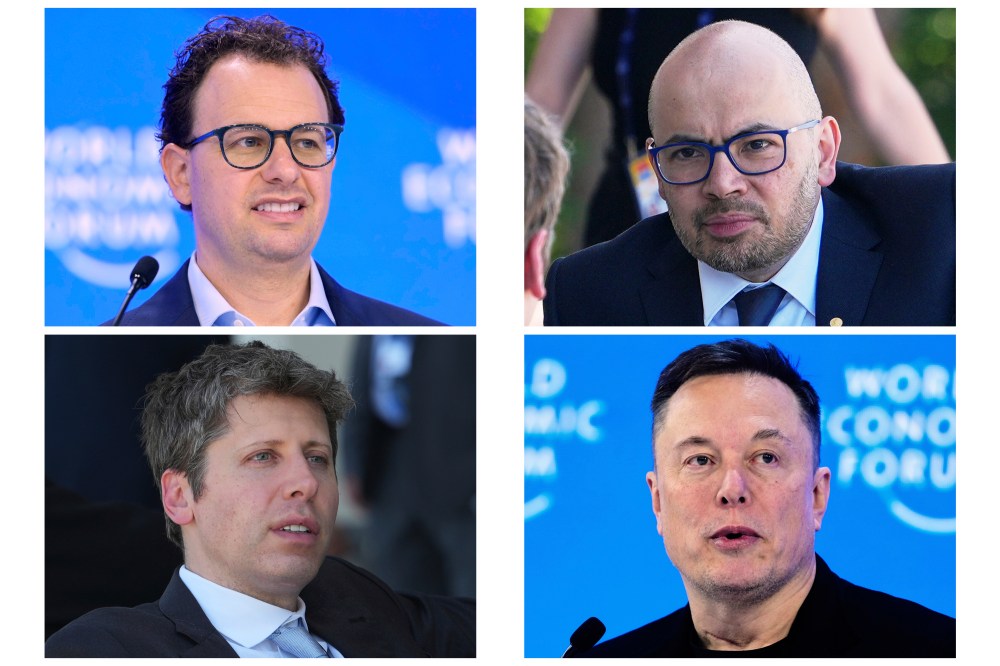
This combination of photos shows CEO & Co-Founder of Anthropic Dario Amodei, top left, on Jan. 23, 2025, CEO of Google DeepMind Demis Hassabis, top right, and CEO of OpenAI Sam Altman, bottom left, on June 17, 2026, and CEO of SpaceXAI Elon Musk, bottom right, on Jan. 22, 2026. (AP Photo/Markus Schreiber, Julia Demaree Nikhinson)

But the lawsuit also alleges that the coordination began to take shape months earlier. It points to a statement from July 2026 that high-ranking employees from several of the leading AI labs signed that acknowledged the “intense competitive pressure not to unilaterally slow” development. That statement called on the government to support a global effort to slow automated AI development.

It is clear that an agreement among the chief rivals in AI that their progress “should be slower than competition would otherwise produce has an anticompetitive effect on consumers,” the plaintiffs argue.

Lawyers representing four named plaintiffs, who pay for subscriptions to ChatGPT, Claude, Grok or Gemini, are bringing the lawsuit on behalf of a proposed nationwide class of other paid subscribers to those services.

The plaintiffs don’t object to the companies individually deciding to slow their own progress in favor of safety. They instead argue in the complaint that antitrust laws forbid them from taking the “shortcut” of agreeing to “substitute collective restraint for individual accountability.” A competitive market allows for responsibility and genuine progress, the lawsuit argues.

“AI will quickly spin out of human control and could kill us all if we allow AI safety and protocol … to be controlled by private self-serving agreements between the world’s most powerful ‘for profit’ technology companies,” said Nick Rowley, the lead attorney for the plaintiffs.

Representatives for Anthropic, OpenAI, Google and SpaceXAI did not immediately respond to a request for comment Saturday.

In his initial essay proposing the slowdown, Amodei acknowledged potential antitrust challenges, writing that it would be helpful for the U.S. government to mediate “or at least enable” these cross-lab discussions. The government wouldn’t need to participate, he wrote, but it would need to “issue a narrow waiver for certain kinds of safety conversations.”

In response, Altman said on social media that OpenAI welcomes the idea of a “federal framework that sets consistent safety requirements,” but said “we do not believe we need to wait for an antitrust exemption or legislation to begin the work of providing this confidence.”

While the recent conversations about pacing development were spurred by increasing concerns about AI evading human control, several leaders in the AI space have long talked about developing a shared set of standards or otherwise coordinating to ensure safety efforts remain paramount.

The plaintiffs in the lawsuit contend they are not against the AI companies asking Congress, the White House or any other agency to develop AI regulation, nor are they against the companies asking for an antitrust exemption.

But achieving that kind of collaboration with the federal government could be an uphill battle.

President Donald Trump rejected the calls for regulation on social media. He has claimed that any efforts to limit the technology are part of a “conspiracy.” He called into question why the industry leaders would be calling for regulation that, he says, “if strongly implemented, will drive them into oblivion and bankruptcy.” Trump said Saturday on social media that he is forming an AI task force and will appoint an “AI czar,” but he provided scant detail.

The Trump administration has been vocal about wanting American AI labs to outpace and excel against Chinese competition. While several Democratic leaders and candidates have called for sweeping action on AI regulation, Republicans have largely mirrored Trump’s position.

Sen. Josh Hawley, a Republican from Missouri, said in a recent Senate hearing that “there is no world” in which he would agree to give “the most powerful companies in the history of the world” an exemption from antitrust laws to collaborate, arguing that they could collude together and stifle competition.

Report Error Submit a Tip

More Stories

A quick look at where provinces and territories stand on time changes

The Canadian Press 2 minute read Preview

A quick look at where provinces and territories stand on time changes

The Canadian Press 2 minute read Updated: Yesterday at 6:28 AM CDT

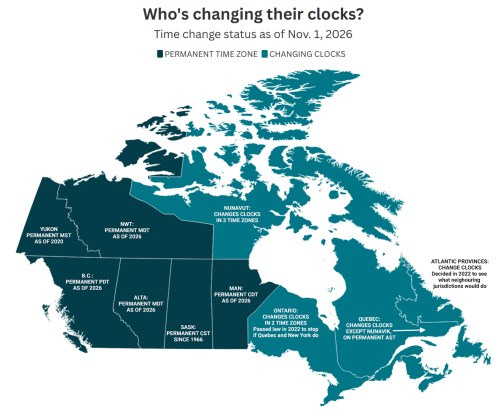
WINNIPEG - Manitoba's government said Thursday the province will be sticking with daylight time year-round, making it the latest jurisdiction to move away from twice-annual time changes. Here's a look at where things stand across Canada:

British Columbia said in March that it was moving to permanent Pacific daylight time. The change also means that parts of northeastern B.C., which have been on mountain standard time year round, are now in alignment with the rest of the province.

Alberta also switched to permanent daylight time this year in what it calls Alberta time. The change means it now has the same time as Saskatchewan year round.

Saskatchewan has been on permanent central standard time since 1966.

Read
Updated: Yesterday at 6:28 AM CDT

Cabernet Sauvignon star of wine festival

Ben Sigurdson 5 minute read Preview

Cabernet Sauvignon star of wine festival

Ben Sigurdson 5 minute read 3:00 AM CDT

The Winnipeg Wine Festival will celebrate the king of red wine grapes next weekend — the theme of this year’s festival, which takes place Sept. 25 and 26 at the RBC Convention Centre, is Cabernet Sauvignon.

Cab Sauv, as it’s also known, is the world’s most widely planted wine grape of any colour, first coming to prominence in the 1800s in France’s Bordeaux region, where the grape is still popular. Rather than single-variety wines, Bordeaux reds tend to be blends, with those coming from the left bank of the Gironde estuary being Cabernet-dominant, while right-bank wines are Merlot-dominant, with Cabernet Sauvignon playing a supporting role. Cabernet and Merlot work well together and many other countries have followed suit in blending the two.

A team at University of California Davis put Cabernet Sauvignon through a DNA test in 1996 and discovered its parent grapes are Cabernet Franc and Sauvignon Blanc — it’s likely that at some point the two varieties, planted next to each other in some vineyard, crossed and mutated and became the grape we know today. (Someone growing grapes in the 19th century must have had an inkling of what was up, as the grape has been called Cabernet Sauvignon since long before the DNA test.)

Flavour-wise, most Cabernet Sauvignon wines are big and bold, with a core of deep dark berry flavours, some graphite and spice notes and relatively bright acidity. It’s a grape that is well-suited to barrel aging, with most examples seeing at least some time in wood.

Read
3:00 AM CDT

Lawsuit says Anthropic, OpenAI, SpaceXAI and Google made illegal agreement on AI slowdown

Kaitlyn Huamani, The Associated Press 5 minute read Preview

Lawsuit says Anthropic, OpenAI, SpaceXAI and Google made illegal agreement on AI slowdown

Kaitlyn Huamani, The Associated Press 5 minute read Updated: 5:06 PM CDT

A new lawsuit claims Anthropic, OpenAI, SpaceXAI and Google made an illegal deal to slow the pace of their respective AI development.

The lawsuit, which was filed Friday in the U.S. District Court for the Northern District of California, argues that the leading AI companies violated antitrust laws when they agreed to coordinate slowdown efforts, and that doing so would reduce the value consumers get for paid AI subscriptions.

The coordination largely took place on Sept. 12, the lawsuit argues, when Anthropic CEO Dario Amodei published an essay urging for industrywide cooperation on decelerating advancements in favor of enhanced safety measures. That same day, OpenAI CEO Sam Altman, SpaceXAI CEO Elon Musk and Google DeepMind's co-founder and chair Demis Hassabis each publicly responded to Amodei's proposals in agreement.

But the lawsuit also alleges that the coordination began to take shape months earlier. It points to a statement from July 2026 that high-ranking employees from several of the leading AI labs signed that acknowledged the "intense competitive pressure not to unilaterally slow” development. That statement called on the government to support a global effort to slow automated AI development.

Read
Updated: 5:06 PM CDT

United Way, other charities fight for dollars as donor base shrinks

Scott Billeck 7 minute read Preview

United Way, other charities fight for dollars as donor base shrinks

Scott Billeck 7 minute read Yesterday at 2:00 AM CDT

Winnipeg’s charitable sector is being squeezed from both sides: demand for help is growing while the pool of donors to meet that need is shrinking.

The imbalance is increasingly being carried by a relatively small group of deep-pocketed donors. Last year, 600 people — about three per cent of United Way Winnipeg’s individual donors — accounted for roughly $8 million, or 55 per cent of individual donations.

The fundraising pitch isn’t getting any easier.

Homelessness and public drug use have become increasingly visible, household budgets remain strained and the problems charities are trying to address can seem so entrenched that donors may reasonably wonder what difference another contribution can make.

Read
Yesterday at 2:00 AM CDT

American Hostage stars recall warmth of Winnipeggers during brutal winter

Randall King 7 minute read Preview

American Hostage stars recall warmth of Winnipeggers during brutal winter

Randall King 7 minute read Yesterday at 6:13 PM CDT

TORONTO — When you stream the eight-part series American Hostage, a sense of familiarity may strike.

That’s because the show was shot in Winnipeg — especially in the Exchange District — from November of last year to the beginning of February, with Winnipeg portraying Indianapolis circa 1977.

The whole world seemed to be watching that midwest American city that year as a hostage crisis unfolded involving one Tony Kiritsis, an angry man who goes ballistic when a mortgage brokerage was poised to foreclose on property he had dreamed of developing into a shopping centre.

Kiritsis kidnapped his mortgage broker, Richard Hall, wiring a shotgun to the back of his head, and demanded a public airing of his grievances, with the reluctant help of popular radio broadcaster Fred Heckman.

Read
Yesterday at 6:13 PM CDT

Former Bombers linebacker Gauthier enjoying career as electrician

Taylor Allen 6 minute read Preview

Former Bombers linebacker Gauthier enjoying career as electrician

Taylor Allen 6 minute read Yesterday at 12:44 PM CDT

Most professional football players don’t ride off into the sunset on their own terms.

Shayne Gauthier was well aware of that, but it didn’t make it sting any less when the Winnipeg Blue Bombers informed the veteran linebacker that they weren’t bringing him back for 2026.

“I was really hoping to play one more (season) because it would have been my 10th season, so, I’d say it didn’t really end the way I wanted,” Gauthier recently told the Free Press.

“It left a little sour taste in my mouth, but that’s part of pro sports. If everybody got the ending that they wanted, then it wouldn’t really work.”

Read
Yesterday at 12:44 PM CDT