WEATHER ALERT

Law

Please review each article prior to use: grade-level applicability and curricular alignment might not be obvious from the headline alone.
No Subscription Required

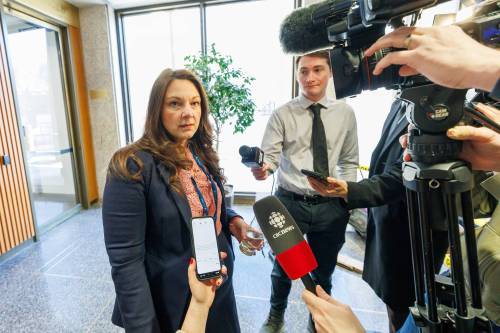
Kinew says watchdog could enforce proposed social media ban

Gabrielle Piché 3 minute read Preview
No Subscription Required

Kinew says watchdog could enforce proposed social media ban

Gabrielle Piché 3 minute read Wednesday, May. 13, 2026

Premier Wab Kinew floated the possibility of using a regulator or commissioner to enforce his proposed ban on social media and artificial intelligence chatbot use for kids.

Read
Wednesday, May. 13, 2026
No Subscription Required

MPs amend bill criminalizing sexual deepfakes to include ‘nearly nude’ images

Anja Karadeglija, The Canadian Press 5 minute read Preview
No Subscription Required

MPs amend bill criminalizing sexual deepfakes to include ‘nearly nude’ images

Anja Karadeglija, The Canadian Press 5 minute read Wednesday, Jun. 3, 2026

OTTAWA - A House of Commons committee has amended a proposed bill that would criminalize sexual deepfakes to ensure it covers "nearly nude" images.

The change to Bill C-16 comes after experts warned the original version of the bill likely would not cover many of the images created by Elon Musk’s Grok chatbot which proliferated on his X platform at the beginning of this year.

The original version of the bill would have criminalized the non-consensual sharing of images which show the subject nude, exposing their sexual organs or engaged in explicit sexual activity. The images created by Grok — such as edits of photos of women to depict them wearing see-through bikinis — may not meet that standard.

MPs on the justice committee voted in favour of amendments put forward by Conservative MP Andrew Lawton to change the wording of the legislation to address images in which the subject is nude or "nearly nude."

Read
Wednesday, Jun. 3, 2026
No Subscription Required

Bear hunting and conservation questions

Jessica Scott-Reid 4 minute read Friday, May. 8, 2026

You don’t have to be an animal rights activist to oppose black bear hunting in Manitoba. You also don’t have to trade in your ethics in order to understand biology. Most animal and nature-loving Canadians can do it all: understand science and care about animal suffering. Well, unless your paycheque requires otherwise.

Such is the case for the author of a recent article for the Free Press (Why claims of sentience can’t guide black bear policy, Think Tank, April 16), Mark Hall, who conservation-washes the killing of black bears in our province. The B.C.-based hunting advocate also conveniently failed to mention his vested interest in the issue, including that the organization he works for is funded by companies in the trophy hunting business. He also failed to follow the actual science.

The fact is, framing Manitoba’s spring black bear hunt as a conservation measure grounded in biology just doesn’t hold up. Especially since it is also marketed by local companies as trophy hunting. “During your bear hunt you will be placed over an active bear bait site (and) with a little patience and some determination you will be able to harvest a trophy of a lifetime,” states one company’s website.

Lesley Fox, executive director of Canadian wildlife protection charity The Fur Bearers, says “heralding the spring bear hunt as conservation is a public relations tactic that supports special interests, not wildlife.”

No Subscription Required

OpenAI did not respect Canadian privacy laws in developing ChatGPT, probe finds

Jim Bronskill and Anja Karadeglija, The Canadian Press 5 minute read Preview
No Subscription Required

OpenAI did not respect Canadian privacy laws in developing ChatGPT, probe finds

Jim Bronskill and Anja Karadeglija, The Canadian Press 5 minute read Thursday, May. 28, 2026

OTTAWA - OpenAI failed to respect Canadian privacy laws when training its artificial intelligence-powered ChatGPT chatbot, federal and provincial watchdogs have found.

The conclusion came Wednesday in a report on a joint investigation by federal privacy commissioner Philippe Dufresne and his counterparts from British Columbia, Alberta and Quebec.

ChatGPT, released in November 2022, is a popular conversation-style tool that responds to online users' prompts with a wide range of information almost instantly — responses that may or may not be accurate.

The privacy watchdogs found OpenAI's collection of information to train its models was overly broad, resulting in the compilation and use of sensitive personal details.

Read
Thursday, May. 28, 2026
No Subscription Required

Man takes First Nation to court over banishment

Erik Pindera 4 minute read Tuesday, May. 5, 2026

A Nisichawayasihk Cree Nation man argues bylaws that authorize mandatory checkstops to enter the community and the banishment of band members from reserve lands are unconstitutional.

Terry Wayne Francois, with lawyers funded by the Justice Centre for Constitutional Freedoms working on his behalf, filed a statement of claim in Manitoba’s Court of King’s Bench last week.

The claim names the First Nation, about 80 kilometres west of Thompson, as defendant. The community, also known as Nelson House, has yet to reply in court.

Francois argues two of the community’s bylaws violate multiple Charter of Rights and Freedoms protections and should be struck down by a judge as unconstitutional.

No Subscription Required

Chartrand lauds court decision as ‘victory for Red River Métis’

Kevin Rollason 4 minute read Preview
No Subscription Required

Chartrand lauds court decision as ‘victory for Red River Métis’

Kevin Rollason 4 minute read Monday, May. 4, 2026

The president of the Manitoba Métis Federation and others have been awarded nearly $12 million in legal fees after an unfounded and unreasonable attack by the Métis National Council, a judge has ruled.

Ontario Superior Court Justice Loretta Merritt said in a 15-page decision released on Monday that she was awarding court costs of $6.02 million to MMF president David Chartrand, $1.3 million to Clement Chartier, the MNC’s former president for almost two decades, and $2.06 million to former MNC executive director Wenda Watteyne.

The judge also awarded $2.4 million in costs to several consulting firms and consultants whose reputations were damaged when they were  falsely accused by the MNC of aiding the unfounded allegations of financial impropriety.

“Mr. Chartier and president (Chartrand) have devoted their lives to advancing the interests of the Métis nation,” Merritt wrote. “Ms. Watteyne dedicated the vast majority of her career to the service of the Métis community.

Read
Monday, May. 4, 2026
No Subscription Required

Empower youth by giving them tools to stay safe online

Jen Zoratti 5 minute read Preview
No Subscription Required

Empower youth by giving them tools to stay safe online

Jen Zoratti 5 minute read Saturday, May. 2, 2026

Do you support banning kids from social media? Do you also post photos of your kids on your Facebook or Instagram?

Whenever the topic of banning social media for kids comes up, as it did again this week when Premier Wab Kinew announced that Manitoba will ban youth from using social media and AI chatbots, we run into a wee bit of cognitive dissonance among the adults.

Many of today’s young people had social media presences long before they were old enough to consent to them — not as users, but as content posted by their parents. Instagram is nearly 16 years old; the iPhone nearly 20. A lot of kids have had digital footprints since the sonogram. Their whole lives are online.

So, as young people who are already on social media transition into social media users themselves, we should, as a society, empower them to make informed decisions about how, where and if they want to show up online, not ban them from platforms they use to connect with their peers, express their creativity and learn about the world. Platforms they’ve grown up around and, in many cases, on.

Read
Saturday, May. 2, 2026
No Subscription Required

Census data does much more than determine population

Kevin Rollason 8 minute read Preview
No Subscription Required

Census data does much more than determine population

Kevin Rollason 8 minute read Friday, May. 1, 2026

The children of families who live in public housing in Tuxedo are more likely to graduate from high school, go to college or university, and less likely to need income assistance when they become adults than their counterparts who live just off Main Street in the North End.

How do we know this? The national census.

Officially known as the Census of Population, in the next few weeks, an estimated 41 million Canadians will receive this year’s census to fill in the boxes that reflect their lives. Most will receive the short form, which census officials say should take only five to 10 minutes to fill out. But 25 per cent of Canadians will receive the lengthier long-form census, which includes more demographic questions, and takes about a half-hour or so to complete, depending on the size of the household.

It’s only when the numbers are tallied that we will know exactly how many people there are in the country.

Read
Friday, May. 1, 2026
No Subscription Required

‘Denial of care’: Doctors worry about refugees as payment requirements take effect

Nicole Ireland, The Canadian Press 6 minute read Preview
No Subscription Required

‘Denial of care’: Doctors worry about refugees as payment requirements take effect

Nicole Ireland, The Canadian Press 6 minute read Saturday, May. 23, 2026

TORONTO - Refugees now have to pay out of pocket for part of their drug prescriptions, mental health counselling, dental services, vision care and health equipment — including wheelchairs — as changes to a federal program take effect.

For decades, Canada's Interim Federal Health Program has provided complete health coverage to refugees and refugee claimants until they are eligible for provincial health plans and benefits.

But starting Friday, they must pay $4 for every prescription and 30 per cent of the cost of supplemental health products and services.

More than a dozen medical, nursing, social work and refugee organizations, including the Canadian Medical Association, the Canadian Paediatric Society, the Canadian Psychiatric Association and the Canadian Nurses Association, have warned that refugees can't afford those co-payments and their physical and mental health will suffer.

Read
Saturday, May. 23, 2026
No Subscription Required

Young Canadians want AI companies to make their chatbots less addictive: report

Anja Karadeglija, The Canadian Press 5 minute read Preview
No Subscription Required

Young Canadians want AI companies to make their chatbots less addictive: report

Anja Karadeglija, The Canadian Press 5 minute read Friday, May. 22, 2026

OTTAWA - A new report focusing on the perspectives of young people says the government should order AI companies to take steps to curb the addictive aspects of their AI chatbots.

It’s one of a series of recommendations made by youth between the ages of 17 and 23 who took part in roundtables across the country.

Participants presented the report — published by McGill University’s Centre for Media, Technology and Democracy and Simon Fraser University's Dialogue on Technology Project — and its recommendations on Parliament Hill on Thursday.

Maddie Case, a youth fellow with the McGill centre, introduced the 25 young people who developed the chatbot recommendations.

Read
Friday, May. 22, 2026
No Subscription Required

Tumbler Ridge families likely to seek US$1 billion in lawsuit against OpenAI: lawyer

Chuck Chiang, The Canadian Press 7 minute read Preview
No Subscription Required

Tumbler Ridge families likely to seek US$1 billion in lawsuit against OpenAI: lawyer

Chuck Chiang, The Canadian Press 7 minute read Thursday, May. 21, 2026

VANCOUVER - An American lawyer representing some of the victims of the Tumbler Ridge, B.C., mass shooting says they will likely be seeking more than US$1 billion in their California legal action against OpenAI and its founder Sam Altman.

Chicago-based Jay Edelson has represented a number of clients in wrongful death cases against the artificial intelligence platform and Altman in the past year.

But Edelson said Wednesday that the Tumbler Ridge shootings in which eight victims were killed was the most egregious case his law firm had encountered, citing catastrophic injuries suffered by child plaintiff Maya Gebala.

The other plaintiffs include the parents of children killed in the attack and the husband of Shannda Aviugana-Durand, a teacher's aide who was also shot dead.

Read
Thursday, May. 21, 2026
No Subscription Required

AI and new era of cyber threats

Kyle Volpi Hiebert 5 minute read Wednesday, Apr. 29, 2026

The chief promise of artificial intelligence is turbocharged productivity. The trade-off? Epic disruption.

No Subscription Required

Time to act on provincial autism strategy

Suzanne Swanton 5 minute read Wednesday, Apr. 29, 2026

I was in attendance in the gallery of the Manitoba legislature on March 19 when Bill 232, The Autism Strategy Act, introduced by Liberal MLA Cindy Lamoureux, passed second reading and moved to the committee stage.

No Subscription Required

Proposed social-media ban for Manitoba children gets likes, thumbs-down

Maggie Macintosh 5 minute read Preview
No Subscription Required

Proposed social-media ban for Manitoba children gets likes, thumbs-down

Maggie Macintosh 5 minute read Tuesday, Apr. 28, 2026

Mia Danyluk had a YouTube channel before she reached double digits. She was 11 years old when she signed up for Snapchat. In Grade 9, she joined Instagram.

Perhaps unsurprisingly, it was on social media that she learned about Manitoba’s plan to ban children and youth from accessing these platforms.

The irony was not lost on her — a 16-year-old who was raised in Winnipeg and on the borderless online world.

“We’re seeing younger and younger kids grow up with an iPad instead of toys in their hands. If we’re exposing kids to screens, we need to teach them online safety,” the high schooler said.

Read
Tuesday, Apr. 28, 2026
No Subscription Required

Kinew threatens billion-dollar fines for tech giants ignoring social-media ban for youths

Carol Sanders 5 minute read Preview
No Subscription Required

Kinew threatens billion-dollar fines for tech giants ignoring social-media ban for youths

Carol Sanders 5 minute read Tuesday, Apr. 28, 2026

Manitoba may impose billion-dollar fines on tech companies that violate a proposed ban on social media and AI chatbots for youths under the age 16.

Read
Tuesday, Apr. 28, 2026
No Subscription Required

Child advocates call for online harms bill covering AI chatbots, gaming

Anja Karadeglija, The Canadian Press 5 minute read Preview
No Subscription Required

Child advocates call for online harms bill covering AI chatbots, gaming

Anja Karadeglija, The Canadian Press 5 minute read Tuesday, May. 19, 2026

OTTAWA -

Ottawa can't afford to wait any longer to introduce new online harms legislation that covers AI chatbots and video games, children’s advocates and about a dozen kids told a press conference on Parliament Hill Monday.

They urged the government to move quickly to introduce its promised online harms bill.

"This is a David and Goliath battle — kids and parents up against a multi-billion dollar tech industry that is profiting off of harming our children," Sara Austin, founder and CEO of Children First Canada, told reporters.

Read
Tuesday, May. 19, 2026
No Subscription Required

OpenAI CEO Sam Altman ‘deeply sorry’ over Tumbler Ridge shooting where 8 were killed

Wolfgang Depner, The Canadian Press 4 minute read Preview
No Subscription Required

OpenAI CEO Sam Altman ‘deeply sorry’ over Tumbler Ridge shooting where 8 were killed

Wolfgang Depner, The Canadian Press 4 minute read Saturday, May. 16, 2026

The head of an artificial intelligence company that admitted it knew of the troubling behaviour of a woman before she killed eight and wounded dozens more in Tumbler Ridge, B.C., has apologized for not going to police.

A letter from OpenAI CEO Sam Altman, shared Friday on B.C. Premier David Eby's social media, said that while he knows words can never be enough, he believes "an apology is necessary to recognize the harm and irreplaceable loss the community has suffered."

He said in the letter addressed to the community of Tumbler Ridge that the pain it has endured is unimaginable and he has thought about them often.

“I am deeply sorry that we did not alert law enforcement to the account that was banned in June," his letter says.

Read
Saturday, May. 16, 2026
No Subscription Required

The pitfalls of increased use of AI in policing

Christopher J. Schneider 5 minute read Tuesday, Apr. 21, 2026

As a part of its body-worn camera program, the RCMP recently completed a pilot project using artificial intelligence to draft reports. The AI-generated reports are created from audio captured from officers’ body cameras. A report can be drafted in mere seconds. The pilot, which ran for about six months and concluded in January, occurred across eight detachments in British Columbia generating nearly 800 reports.

Harnessing AI to write police reports is replete with some serious and unresolved concerns and must be immediately discontinued.

It isn’t even entirely clear why police need to use AI in the first place.

The primary justification for the expanding use of AI to generate police reports across law enforcement is to free police from the administrative burden of having to write reports in the first place. The idea is that officers could do more relevant police work, presumably patrol work.

No Subscription Required

Former chief psychiatrist legally challenges Manitoba’s detox detention laws

Dan Lett 4 minute read Preview
No Subscription Required

Former chief psychiatrist legally challenges Manitoba’s detox detention laws

Dan Lett 4 minute read Sunday, Apr. 19, 2026

Manitoba’s former chief psychiatrist is challenging the constitutionality of a controversial law allowing the province to incarcerate intoxicated people for up to 72 hours, claiming that it will harm those suffering from mental illness or disabilities.

Dr. Jim Simm, an outspoken critic of the Protective Detention and Care of Intoxicated Persons Act, said in an exclusive interview on Sunday that he is seeking leave from the Court of King’s Bench to challenge the law violates provisions of the Charter of Rights and Freedoms.

“We’re talking about human beings who are suffering,” Simm said. “They may be acting badly but to be putting them in solitary confinement — it’s just wrong.”

As it stands now, the legislation allows someone who appears intoxicated to be held for 24 hours at a “detention location,” and then held for up to 72 additional hours at a “preventative care centre.”

Read
Sunday, Apr. 19, 2026
No Subscription Required

B.C. ‘chemical fingerprint’ scheme to track illicit drugs is likened to DNA tests

Marissa Birnie, The Canadian Press 4 minute read Preview
No Subscription Required

B.C. ‘chemical fingerprint’ scheme to track illicit drugs is likened to DNA tests

Marissa Birnie, The Canadian Press 4 minute read Saturday, May. 9, 2026

VANCOUVER - Tucked in the basement of the chemistry building at the University of British Columbia, an arm-sized robot carries out the repetitive task of collecting and weighing colourful vials as machinery whirrs in the background.

It's part of a unique blend of robotics, chemistry and artificial intelligence aimed at helping police and health officials trace the path of batches of illicit drugs.

Police hope the "chemical fingerprinting" program is a game-changer in B.C.'s battle against toxic illicit drugs, with one senior officer likening it to DNA testing.

The provincially funded program will use technology developed at UBC by Aidos Innovations that looks at the chemical makeup of drugs and calculates their method of production, which police say could help them learn how drugs move over time.

Read
Saturday, May. 9, 2026
No Subscription Required

AI content should be labelled, heritage committee says

Anja Karadeglija, The Canadian Press 2 minute read Preview
No Subscription Required

AI content should be labelled, heritage committee says

Anja Karadeglija, The Canadian Press 2 minute read Saturday, May. 9, 2026

OTTAWA - The government should require that content generated by artificial intelligence be clearly labelled, a House of Commons committee said in a new report.

The members of Parliament on the committee are calling for standardized labels for AI content that are visible and that the public can understand. They say the requirement should apply to all relevant sectors, including digital platforms and broadcasters.

This would "promote transparency, maintain public trust and preserve the integrity of Canada’s information and cultural ecosystem," the report said.

It called on the government to establish "a framework governing the systematic and easily identifiable labelling of content created with the assistance of artificial intelligence, including through the use of metadata, digital watermarks or other robust technical solutions."

Read
Saturday, May. 9, 2026
No Subscription Required

First Nations chiefs call for inquiry into RCMP after CBC report on surveillance

Alessia Passafiume, The Canadian Press 5 minute read Preview
No Subscription Required

First Nations chiefs call for inquiry into RCMP after CBC report on surveillance

Alessia Passafiume, The Canadian Press 5 minute read Saturday, May. 9, 2026

OTTAWA - First Nations leaders called on the RCMP to apologize and demanded a federal inquiry Thursday after CBC reported the police service spied on Indigenous political leaders in the 1960s and beyond.

CBC Indigenous uncovered some 6,000 pages of internal RCMP documents that indicate the RCMP was monitoring Indigenous political activity as early as 1968.

The CBC report said police targeted future national chiefs Noel Starblanket, David Ahenakew, Georges Erasmus and Phil Fontaine. CBC Indigenous reported that Ovide Mercredi, who also went on to serve as national chief, was mentioned in the files.

Assembly of Manitoba Chiefs Grand Chief Kyra Wilson said the RCMP should apologize directly to community members, on their own territories, by the end of the year for the "Native extremism" program.

Read
Saturday, May. 9, 2026
No Subscription Required

U.S. leads spike in applications for Canadian citizenship by descent

David Baxter, The Canadian Press 4 minute read Preview
No Subscription Required

U.S. leads spike in applications for Canadian citizenship by descent

David Baxter, The Canadian Press 4 minute read Saturday, May. 9, 2026

OTTAWA - Interest in Canadian citizenship by descent among citizens in a handful of countries — especially the United States — surged after the federal government passed a new law clarifying the rules.

C-3, which took effect on Dec. 15, 2025, allows someone born outside Canada before that date to a Canadian parent who also was born outside Canada to file a citizenship claim. Anyone born or adopted on or after Dec. 15, 2025 can make a claim as long as the parent, who was also born or adopted abroad, spent at least three years in Canada before their child's birth or adoption.

The law was drafted and passed in response to a 2023 Ontario Superior Court order that found a law on citizenship by descent passed by Stephen Harper's government was unconstitutional.

That Harper-era law said Canadians who were born abroad could only pass down their citizenship if their children were born in Canada.

Read
Saturday, May. 9, 2026
No Subscription Required

Couple fights city to retain 11-foot-plus fence

Nicole Buffie 4 minute read Tuesday, Apr. 14, 2026

A notable Winnipeg couple are fighting a city order to reduce the size of their more than 11-foot fence — which is much higher than allowed under city regulations.

Lynne Skromeda and Jason Smith built a fence in 2023 as part of renovations to their McMillan neighbourhood backyard. A neighbour filed a complaint and city bylaw inspectors ruled the fence was too high. The city later approved a variance application to allow for a seven-foot, five-inch fence.

“In 2023, the applicant worked with urban planning to arrive at a compromised height of 7.5 feet and the applicant advised they would reduce the fence height accordingly. Further inspections at the site reveal that the applicant did not complete the necessary reduction to the fence height to meet the supported and approved height of 7.5 feet,” says a report prepared for an April 20 appeal hearing.

The city’s limit on fence height is six-feet, six inches for rear and side yards, and four feet in front yards. The fence in dispute is more than 11 feet high along a portion of the west side yard and more than eight feet along the rear yard.