Search Results
Please review each article prior to use: grade-level applicability and curricular alignment might not be obvious from the headline alone.

Democracy is a civic election issue
4 minute read Preview Thursday, Aug. 13, 2026Differing goals of religion, politics
4 minute read Thursday, Aug. 13, 2026Kudos to David Driedger for modelling a more appropriate and constructive role for religion in politics than the one that has become commonplace today (Take care of them; there is enough, Think Tank, July 27).
Resisting the temptation to preach, coerce and control, he has chosen to remind, persuade and challenge. It could hardly more different to what we are witnessing everyday to the south of us. I thank him for his humility, courage and sense of responsibility to humanity.
Our recent experiences with religion’s forays into the political realm, both in the U.S. and parts of Canada have done little to endear us to either one. Religious fundamentalism, in its many forms, has wrought untold havoc on governments across the globe, with some of the most toxic iterations being right on our doorsteps — we might even call it a form of domestic terrorism.
In the U.S., Christian nationalism, represented by MAGA, has contaminated government and ordinary lives like a hazardous toxin escaping containment — corroding and poisoning the presidency, the legislature, the court system and law enforcement, and in the process threatening the very relationships which make a civilized society possible. Simply put, the positive ideal of godliness in the American constitution, which emphasized tolerance for, acceptance of and upheld the equal worth of all peoples is in peril.

Unsafe conditions force Sea Bears, Honey Badgers into winner-take-all CEBL final in Winnipeg Saturday
4 minute read Preview Thursday, Aug. 13, 2026
HSC nurses concerned info hacked in cyberattack
3 minute read Preview Wednesday, Aug. 12, 2026
Bringing home a Fish: Group of local baseball fans open doors to Goldeyes
7 minute read Preview Wednesday, Aug. 12, 2026
City charter ties council’s hands in wake of criminal allegations against Transcona councillor
5 minute read Preview Wednesday, Aug. 12, 2026
Ridesharing platform lets people connect with local drivers with trucks, cargo vans
4 minute read Preview Wednesday, Aug. 12, 2026
Spotty service, U.S. roaming charges leave Somerset woman calling for answers
5 minute read Preview Wednesday, Aug. 12, 2026
Libau man warns Manitobans after contracting West Nile Virus
3 minute read Preview Wednesday, Aug. 12, 2026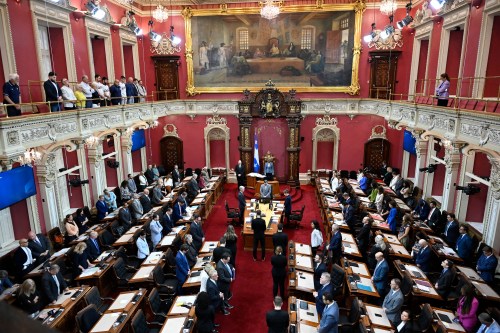
Lawyer challenges Quebec’s law ending manadatory oath of allegiance to the King
3 minute read Preview Friday, Sep. 4, 2026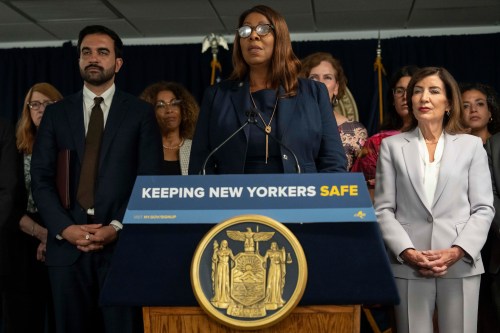
ICE’s plan to give officers electric shock gloves draws outrage and fears of misuse
4 minute read Preview Thursday, Aug. 13, 2026
Organization works to support Black politicians as they face barriers, discrimination
4 minute read Preview Friday, Sep. 4, 2026
Insolvencies jumped 11.5% annually in June, Canada’s bankruptcy monitor shows
3 minute read Preview Friday, Sep. 4, 2026
Federal government invests $24 million for cannabis and brain health research
2 minute read Preview Thursday, Aug. 13, 2026
Federal government announces $34M to help communities cope with climate change
2 minute read Preview Thursday, Aug. 13, 2026
Fun drop-in last chance to mentor grads of inner-city school with excellent track record
5 minute read Preview Wednesday, Aug. 12, 2026
A mission to make hearing care easier to access
4 minute read Preview Wednesday, Aug. 12, 2026
Quiet opening fitting for controversial site
4 minute read Preview Wednesday, Aug. 12, 2026‘Artificial intelligence’ based on large language models is shaping up to be the most efficient destroyer of value since the South Sea Bubble. After “the Crash”, which is inevitably coming, some specific functions of AI will eventually turn out to be genuinely revenue-generating, and a lot of jobs will duly disappear. But the biggest winner (and potentially biggest loser) is medical science.
Dr. Brian Hie, a chemical engineer at Stanford University in California, has just revealed that his team has made the first viruses designed by artificial intelligence. They are ‘bacteriophages’, viruses that only infect bacteria and are widely used to treat people with infections that resist other treatments.
However, natural bacteriophages sometimes fail, so Dr. Hie used generative AI to design new ones that might do the job. The AI generated thousands of designs for new genomes that more or less fit the bill, and he chose around 300 of them to build in the lab. It’s hard work, not magic, but he ended up with 16 ‘novel’ bacteriophages that might work.
He applied them to petri dishes containing two harmful strains of E. coli, a common bacteria that lives in the human gut, and they killed the bacteria off. It’s still early days, but if it is truly becoming possible to tailor-make bacteriophages that target specific bacteria, then we may be getting a major new weapon in the struggle against antibiotic resistance.

Governments pledge ‘storefront success’ with downtown grants
4 minute read Preview Tuesday, Aug. 11, 2026