Forecast: Famine

City charity hopes federal matching will spur donations for Sahel region

2 minute read Tuesday, Aug. 7, 2012

A Winnipeg charity is urging people to give in order to help end the humanitarian crisis in the Sahel region of sub-Saharan Africa, after the federal government announced today it will match dollar-for-dollar Canadian donations made to end the crisis.

Winnipeg-based Foodgrains Bank is one of many registered Canadian charities responding to the crisis through the government’s Sahel Crisis Matching Fund.

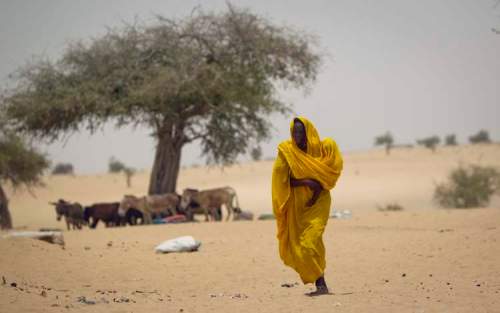
Drought, rising food costs, population displacement and insecurity have contributed to the food and nutrition crisis in the region. The Sahel region of Africa stretches from the Atlantic Ocean to the Red Sea and includes Niger, Mali, Burkina Faso, Chad, Mauritania, Senegal, Gambia and northern Cameroon as some of the most affected countries.

Foodgrains said they have an appeal in the region called the Sahel Emergency Food Appeal, where funds will be matched by the government. They have committed 10,000 tonnes of food worth $9.7 million to Niger, Mali and Burkina Faso. The federal government has also contributed $10 million to the Sahel Crisis Matching Fund on top of matching donations.

Advertisement
Advertise With Us

Weather

Apr. 10, 12 PM: 1°c Sunny Apr. 10, 6 PM: 3°c Sunny

Winnipeg MB

-3°C, Clear

Full Forecast

Climate chaos: what the Sahel can teach us

By Bartley Kives 21 minute read Preview

Climate chaos: what the Sahel can teach us

By Bartley Kives 21 minute read Saturday, Jul. 14, 2012

YATAKALA, Niger -- On a dusty orange plain in the extreme western corner of Niger, a small group of Manitobans marvels at what the local Djerma-Songhay people consider soil.

It's the middle of May, toward the end of the long dry season in this part of the Sahel, a wide band of semi-arid land that stretches across the centre of Africa. In a couple of weeks, rains are expected to come, allowing subsistence farmers to plant millet, cowpeas and other crops adapted to what may be the most marginal agricultural land on the planet.

The surface of the Sahel is baked by furnace-like heat, enjoys minimal moisture and has earth so brittle, it resembles what most Canadians would call sand. When you cup two hands full of dry Sahelian soil, it slides out of your fingers like the fine silica of Grand Beach.

It's tough to imagine there's much in the way or organic material in this orange silt, let alone enough to nurture the growth of vegetation.

Read
Saturday, Jul. 14, 2012

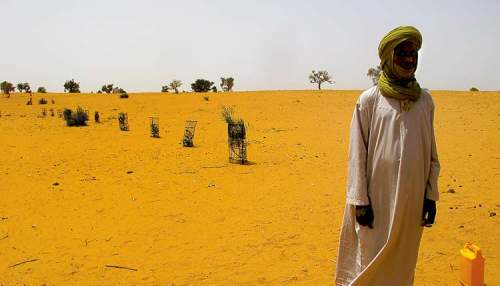
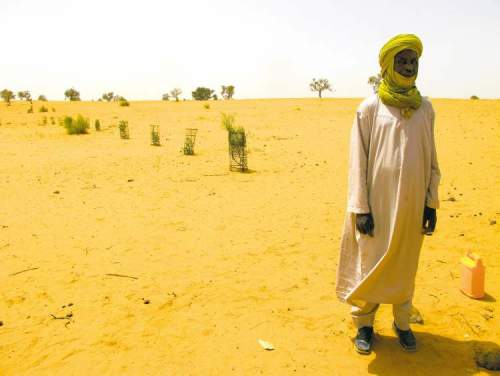
A test pilot pf drought-resistant trees outside Yatakala, Niger, at the limits of the arable land in the Sahel, a semi-arid band of Africa that sits below the Sahara Desert.

A test pilot pf drought-resistant trees outside Yatakala, Niger, at the limits of the arable land in the Sahel, a semi-arid band of Africa that sits below the Sahara Desert.

Kives sharing lessons from Niger at News Café Monday

1 minute read Preview

Kives sharing lessons from Niger at News Café Monday

1 minute read Wednesday, Jul. 4, 2012

Join us at 7 p.m. Monday as Free Press reporter Bartley Kives shares photos and observations from a recent trip to the central African nation of Niger.

In May, Kives tagged along with humanitarian groups as they crisscrossed southern Niger, a country that ranks as one of the most environmentally devastated places on Earth. Nigeriens are dealing with rapid population growth, food-security issues, climate change, regional instability and an overall shortage of resources that may be difficult for Canadians to conceive.

Bartley will share images and thoughts from his time in Niger and will try to figure out what lessons the rest of the world can take from what the nation is experiencing.

Read
Wednesday, Jul. 4, 2012

BARTLEY KIVES / WINNIPEG FREE PRESS
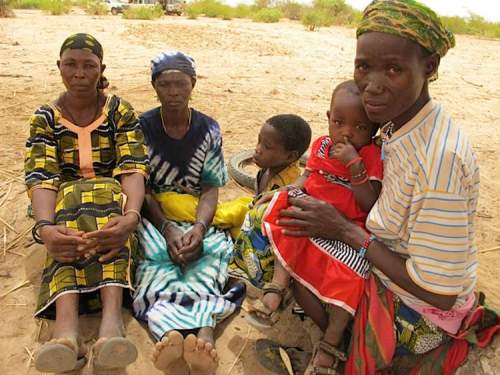
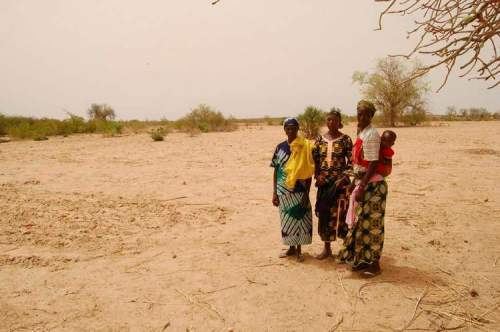
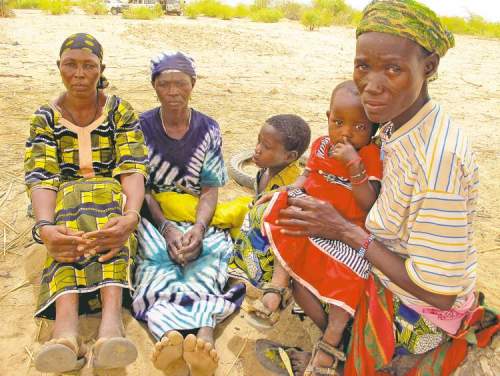
Yapoa Lale (right, with daughter Martine) in the village of Tamfanou, Niger, seen with (from left) Marie Unalile and Marie Boyema.

BARTLEY KIVES / WINNIPEG FREE PRESS
Yapoa Lale (right, with daughter Martine) in the village of Tamfanou, Niger, seen with (from left) Marie Unalile and Marie Boyema.

Home, comfortable home

This City / By Bartley Kives 6 minute read Preview

Home, comfortable home

This City / By Bartley Kives 6 minute read Sunday, May. 27, 2012

So a Jewish guy and some Christians travel across a Muslim country. It sounds like a joke in search of a punchline, but it's actually how I spent much of the month of May.

For 12 days, I found myself in the back of a Toyota Land Cruiser on a highway in Niger, one of Africa's least developed countries, driving between isolated farming villages and the dusty capital, Niamey.

I was effectively embedded with two staffers from the Winnipeg-based Canadian Foodgrains Bank, an umbrella organization for 15 Canadian Christian charities. The CFGB finances food-aid and food-security programs across the Sahel region, where millions face malnutrition in the coming months due to a complex array of environmental, social and geopolitical factors.

Niger suffers from droughts, floods, crop failures, deforestation, soil erosion, rapid population growth, high child mortality and low education. The average Nigerien woman has 7.5 children. Wars or civil conflicts consume most of the neighbouring countries. The average daytime high in May is 42 C, a temperature even people living on the edge of the Sahara Desert do not consider comfortable.

Read
Sunday, May. 27, 2012

Winnipeg Free Press
Going from a looming food crisis to a flap about NHL freebies is a jarring transition.

Winnipeg Free Press
Going from a looming food crisis to a flap about NHL freebies is a jarring transition.

Diverse, yet peaceful

4 minute read Preview

Diverse, yet peaceful

4 minute read Wednesday, May. 16, 2012

TAGENTASSOU, Niger -- If there's a reason for hope in impoverished, environmentally challenged Niger, it's the absence of ethnic tension that has torn apart other developing countries.

A sizeable chunk of the population in this mostly agricultural African nation faces a potential food crisis this summer. Niger is also struggling with climate variability, rapid population growth, deforestation, underdevelopment and unsustainable agricultural practices.

Given these conditions, you might expect Nigeriens to be at each other's throats. Yet a diverse array of ethnic groups coexists relatively peacefully in this young nation, which gained independence from France in 1960.

"People in this country respect each other," said Nigerien development worker Tchady Harouna, a Muslim working for a Catholic non-governmental agency.

Read
Wednesday, May. 16, 2012

BARTLEY KIVES / WINNIPEG FREE PRESS
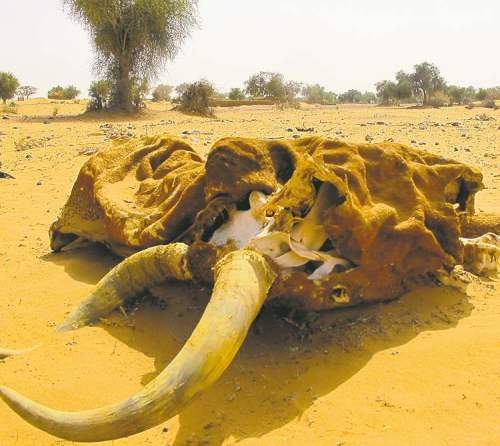
A carcass lies on the side of a dirt track in Niger.

BARTLEY KIVES / WINNIPEG FREE PRESS
A carcass lies on the side of a dirt track in Niger.

More mouths but less to feed them

By Bartley Kives 4 minute read Preview

More mouths but less to feed them

By Bartley Kives 4 minute read Tuesday, May. 15, 2012

DOGON DAWA, Niger -- Amina Moussa has six children. Her husband's two other wives have another eight in total. Factor in the four adults, and this south-central Nigerien household has 18 mouths to feed.

By the standards of a developed nation, this is an immense number of people under one roof. But it's pretty much average for Niger, one of the world's least developed countries -- and home to the planet's highest birthrate.

The average woman in Niger has 7.5 children. For every 1,000 people in this African nation, there will be 50 live births this year, according to Nigerien estimates. Though offset somewhat by high child mortality, the Nigerien population is nonetheless growing at a rate of roughly 3.5 per cent per year.

The official population, based on a 2010 estimate, is 15.3 million. The actual population is likely closer to 16 million. The UN expects that figure to swell to 22 million by 2025.

Read
Tuesday, May. 15, 2012

BARTLEY KIVES / WINNIPEG FREE PRESS
Roadside billboard intended to promote condom use says, 'My hat is my companion.'

BARTLEY KIVES / WINNIPEG FREE PRESS
Roadside billboard intended to promote condom use says, 'My hat is my companion.'

Paradox of hunger in Niger

By Bartley Kives / Forecast: Famine 5 minute read Preview

Paradox of hunger in Niger

By Bartley Kives / Forecast: Famine 5 minute read Monday, May. 14, 2012

MARADI, Niger -- On the side of a highway connecting Niamey to the Burkina Faso border, bisected goat and mutton carcasses hang from the ceilings of open-air butcher shops.

At gas stations in the town of Dosso, you can pick up pineapples trucked north from Benin.

And in pretty much any community of significant size in Niger, you'll find market vendors hawking mangoes, tomatoes and purple-skinned sweet onions, bread merchants balancing metal platters of dry baguettes on their heads and dry-goods stores with bags of rice, maize and millet piled up to the ceiling.

To North American eyes, the presence of all this food seems at odds with widespread concerns about the risk of famine over the next few months. Unfortunately, the existence of food in any given country does not necessarily mean the people living there have access to it.

Read
Monday, May. 14, 2012

Photos by Bartley Kives/ Winnipeg Free Press
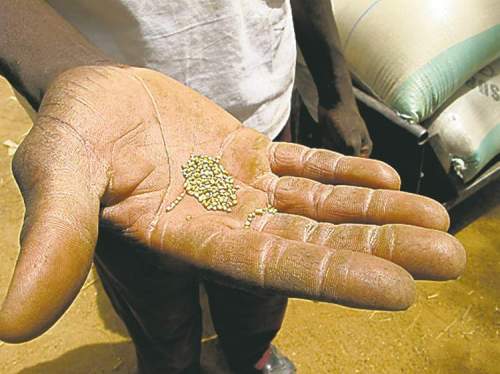
A man holds a handful of grains of millet, the staple of the Nigerien diet.

Photos by Bartley Kives/ Winnipeg Free Press
A man holds a handful of grains of millet, the staple of the Nigerien diet.

‘Crescent moons’ stave off starvation

By Bartley Kives / Forecast: Famine 4 minute read Preview

‘Crescent moons’ stave off starvation

By Bartley Kives / Forecast: Famine 4 minute read Saturday, May. 12, 2012

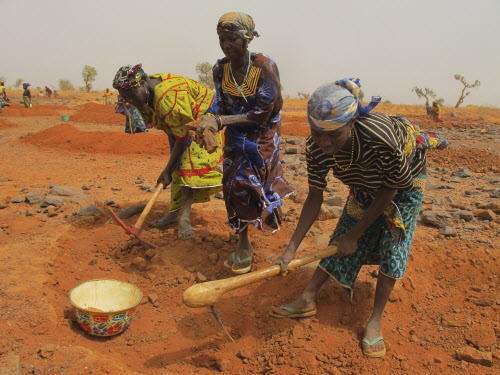
GALMA COMMUNE, Niger -- Beneath a sweltering midday sun, women and children use pickaxes, hoes and bowls to scrape away at hard orange soil on a rocky hillside west of the town of Madaoua.

The unlikely work crew includes young mothers with babies on their backs, older women with remarkably defined biceps and little kids barely as tall as their shovels. There are a few adult men on the hill, but most are acting as supervisors.

To North American eyes, this looks like some bizarre form of chain gang. But these women and children are here of their own accord.

They're taking part in a food-for-work program that allows Nigeriens at risk of going hungry to receive grain in exchange for helping restore vegetation in this environmentally degraded African nation.

Read
Saturday, May. 12, 2012

BARTLEY KIVES / WINNIPEG FREE PRESS
Women in Galma Commune in south-central Niger dig a crescent moon to trap rain water as part of a work-for-food program.

BARTLEY KIVES / WINNIPEG FREE PRESS 
Women in Galma Commune in  south-central Niger dig a crescent moon to trap rain water as part of a work-for-food program.

Fortress of food

By Bartley Kives 5 minute read Preview

Fortress of food

By Bartley Kives 5 minute read Friday, May. 11, 2012

TORODI COMMUNE, Niger -- In a village of adobe-style mud-brick houses, thatched-straw storage huts and thorn-bush fences, a concrete bunker with locking metal doors looks out of place.

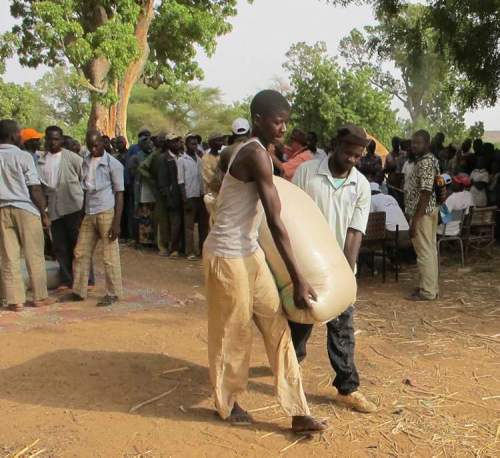
But this structure and dozens like it across Niger may be the most important buildings in the African nation in the coming months. Behind the metal doors sit stacks of 100-kilogram bags of millet, the staple food of the Nigerien diet -- and the crop that failed most spectacularly during the drought of 2011.

Over the past two weeks, development and relief organizations have begun distributing millet in villages across Niger, where roughly 80 per cent of the population relies on subsistence agriculture to survive.

There is more than enough food in Niger to feed the entire population of 16 million. The issue is the cost of millet, cowpeas, cooking oil and other staples have soared beyond the means of most ordinary villagers.

Read
Friday, May. 11, 2012

photos by bartley kives / winnipeg free press
Men carry a 100-kilogram bag of millet as they leave a distribution centre in western Niger.

photos by bartley kives / winnipeg free press
Men carry a 100-kilogram bag of millet as they leave a distribution centre in western Niger.

Trees, shrubs vanishing from Sahel

By Bartley Kives 5 minute read Preview

Trees, shrubs vanishing from Sahel

By Bartley Kives 5 minute read Thursday, May. 10, 2012

TORODI COMMUNE, Niger -- On the side of a dirt track in southwestern Niger, long rows of neatly stacked wood tell the tale of the nation's deforestation.

When farmers in the Sahel region find themselves short on food, one of the common coping strategies involves cutting down trees, selling the wood and using the cash to buy millet and other staples.

This in itself would be disastrous in one of the most environmentally degraded places on the planet. But wood sales are only one reason Niger's trees are disappearing.

Decades of declining agricultural productivity have led millet and sorghum farmers to plant crops on every available patch of land, which often means removing the trees and shrubs that hold the soil in place.

Read
Thursday, May. 10, 2012

BARTLEY KIVES / WINNIPEG FREE PRESS
Trees planted in a test plot try to survive in sandy soil near the border with Mali on the edge of the Sahara Desert.

Photos by BARTLEY KIVES / WINNIPEG FREE PRES

BARTLEY KIVES / WINNIPEG FREE PRESS
Trees planted in a test plot try to survive in sandy soil near the border with Mali on the edge of the Sahara Desert.

Photos by BARTLEY KIVES / WINNIPEG FREE PRES

Warming a worry for all

2 minute read Preview

Warming a worry for all

2 minute read Thursday, May. 10, 2012

Bartley Kives is to be congratulated for his articles on hunger in Niger. The two areas in the world where global warming is happening most rapidly are in the Sahel, where Niger is located, and in Canada's Arctic.

In both places, the temperature is rising more rapidly than on the rest of our planet. Rising temperatures and increased drought are particularly harmful in Niger, where crops may fail if not enough rain falls. In Canada, we are monitoring the rapid ice melt, but hunger is not plaguing most of us yet.

Perhaps some think climate changes will not harm people on Earth. Yet cyclones are increasing and rainfall at various spots is sometimes increasing and often decreasing.

It may be troubling for people in Niger and in the Arctic to realize they may not have contributed much to the famine that plagues the African region or to the melting that is happening in Northern Canada.

Read
Thursday, May. 10, 2012

BARTLEY KIVES / WINNIPEG FREE PRESS
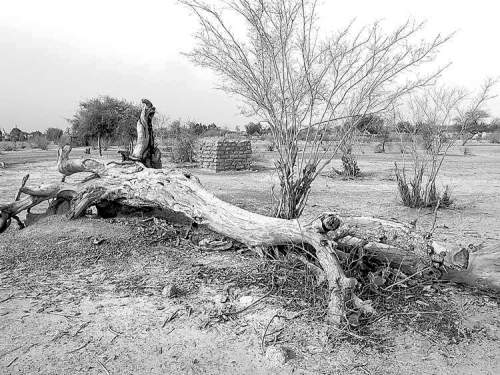
Niger�s soil is parched at the end of the dry season in early May.

BARTLEY KIVES / WINNIPEG FREE PRESS
Niger�s soil is parched at the end of the dry season in early May.

Securing food for Niger a risky business

By Bartley Kives 5 minute read Preview

Securing food for Niger a risky business

By Bartley Kives 5 minute read Wednesday, May. 9, 2012

YATAKALA, Niger-- When the first of three recent droughts hit Niger in 2005, a non-governmental organization called Samaritan's Purse began working with Djerma and Songhay villagers living near the border with Mali.

This corner of the African nation is among the most marginal farmland in the Sahel region. During the dry season, the sandy soil around villages such as Kalmane and Yatakala is hard to distinguish from the Sahara Desert sands just a few kilometres to the north.

At first, Samaritan's Purse helped out the villagers by distributing nutritional supplements. When another drought hit in 2009, the NGO began supplying livestock and gardening education to improve food security.

The most recent drought, in 2011, has left the area in need of actual food aid, which has already started flowing.

Read
Wednesday, May. 9, 2012

Bartley Kives / Winnipeg Free Press
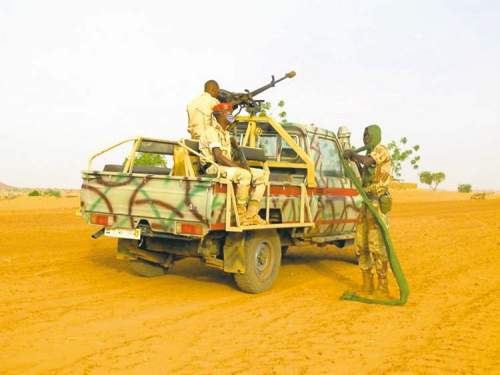
The Nigerien presidential guard serves as an escort for NGOs travelling between villages near unstable Mali.

Bartley Kives / Winnipeg Free Press
The Nigerien presidential guard serves as an escort for NGOs travelling between villages near unstable Mali.

Vicious cycle

By Bartley Kives 4 minute read Preview

Vicious cycle

By Bartley Kives 4 minute read Tuesday, May. 8, 2012

TAMFANOU, Niger -- Three years ago, this entire agro-pastoral village in southwestern Niger packed up and moved 15 kilometres deeper into the scrubland.

The traditional way of life -- farming millet and sorghum, raising sheep and goats -- wasn't yielding enough food at the old village site for this community of ethnic Gourmantche, a predominantly animist and Christian minority in Niger.

The new location for the village, far from a surface-water source, was rendered habitable by a borehole that served as the town well. The villagers of Tamfanou erected homes and storage huts, planted their fields and tended to their animals.

Now the men and women are growing thin, the teenagers aren't growing tall and infants appear to be suffering from malnutrition.

Read
Tuesday, May. 8, 2012

Emily Cain for the Winnipeg Free Press
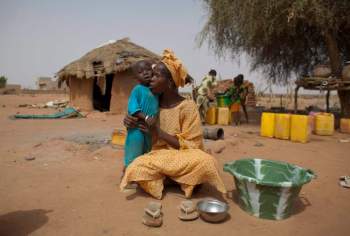
'The hunger is one of the worst sicknesses you can have. If you are hungry, you cannot produce anything,' mother of seven Yapoa Lalé said through a translator, sitting on chalk-coloured, bone-dry soil below the shade of a tree. Pictured: Yapoa Lale (right) with daughter Martine in Tamfanou, Niger.

Emily Cain for the Winnipeg Free Press
'The hunger is one of the worst sicknesses you can have. If you are hungry, you cannot produce anything,' mother of seven Yapoa Lalé said through a translator, sitting on chalk-coloured, bone-dry soil below the shade of a tree. Pictured: Yapoa Lale (right) with daughter Martine in Tamfanou, Niger.

Hope turns to dust in Niger

Bartley Kives 4 minute read Preview

Hope turns to dust in Niger

Bartley Kives 4 minute read Monday, May. 7, 2012

NIAMEY, Niger -- The clay soil is reddish-orange, the cloudless sky is grey with dust and the temperature is a furnace-like 41 C.

Wagon-pulling donkeys share the streets with shiny Land Rovers; goats pick over piles of plastic garbage, and yellow-headed lizards called margouillats scamper swiftly over stucco walls.

At night, the electricity flickers on and off as the heavy air hangs completely still and the temperature plunges to a less-suffocating 32 C.

Welcome to Niamey, the capital of Niger, one of the world's largest, most impoverished and most obscure nations, the latter at least to westerners.

Read
Monday, May. 7, 2012

Bartley Kives/ Winnipeg Free Press
Niger is one of the most impoverished countries in the world, where education, health care and food are a luxury to many of the 15.3 million people who live there.

Bartley Kives/ Winnipeg Free Press
Niger is one of the most impoverished countries in the world, where education, health care and food are a luxury to many of the 15.3 million people who live there.

The suffering Sahel

By Bartley Kives 7 minute read Preview

The suffering Sahel

By Bartley Kives 7 minute read Saturday, May. 5, 2012

Niamey, Niger -- For the second time in as many years, a food-security crisis is looming over Africa, this time over a broad and rain-starved swath of the continent known as the Sahel.

Food shortages in the Horn of Africa threatened the lives of millions in 2011. Local and international relief efforts prevented famine conditions from arising in Kenya and Ethiopia, but mass deaths occurred in Somalia due to the failed state's inability to mount an effective response to food shortages.

The United Nations fears a similar crisis is taking shape this year in the Sahel, a semi-arid strip of Africa that stretches from the Atlantic Ocean to the Red Sea, on the southern fringe of the Sahara Desert.

Drought and crop failures threaten the food security of millions in Mauritania, Senegal, Cameroon, Mali, Burkina Faso, Niger, Nigeria and Chad, the nations that collectively make up the West African portion of the Sahel. Estimates of the number of people at risk of hunger or malnutrition vary from six million to 15 million.

Read
Saturday, May. 5, 2012

Ben Curtis / The Associated Press archives
A woman takes her baby to be examined for signs of malnutrition at a walk-in feeding centre in Dibinindji, a desert village in the Sahel belt of Chad. The Sahel has experienced rapid population growth and drought.

Ben Curtis / The Associated Press archives
A woman takes her baby to be examined for signs of malnutrition at a walk-in feeding centre in Dibinindji, a desert village in the Sahel belt of Chad. The Sahel has experienced rapid population growth and drought.

LOAD MORE