Breaking the ice
Competitive figure skater finds happily ever after with travelling Disney show

Advertisement
Read this article for free:
or
Already have an account? Log in here »
To continue reading, please subscribe:

Digital Subscription
One year of digital access for only $205*
- Enjoy unlimited reading on winnipegfreepress.com
- Read the E-Edition, our digital replica newspaper
- Access News Break, our award-winning app
- Play interactive puzzles
*First annual payment billed as $205.00 + GST for one year. This annual subscription will automatically renew at $233.00 + GST every 52 weeks (10% off the regular annual price of $259.35). Offer available to new and qualified returning subscribers only. Cancel any time.
To continue reading, please subscribe:
Add Free Press access to your Brandon Sun subscription for only an additional
$1 for the first 4 weeks*
- Enjoy unlimited reading on winnipegfreepress.com
- Read the E-Edition, our digital replica newspaper
- Access News Break, our award-winning app
- Play interactive puzzles
*Your next Brandon Sun subscription payment will increase by $1.00 and you will be charged $17.95 plus GST for four weeks. After four weeks, your payment will increase to $24.95 plus GST every four weeks.
Read unlimited articles for free today:
or
Already have an account? Log in here »
Hey there, time traveller!
This article was published 14/11/2024 (674 days ago), so information in it may no longer be current.
Jasmine Bezugly grew up in Borden, a small town an hour outside of Saskatoon, Sask. She learned to skate when she was three years old on a frozen pond on her family’s farm and hasn’t looked back since.
The 27-year-old competitive figure skater, who also trained in ballet, contemporary dance and musical theatre, has been performing with Disney on Ice for eight years. She plays Jessie from Toy Story in the Disney on Ice production Mickey’s Search Party.
What led you to join Disney on Ice?

Feld Entertainment
Jasmine Bezugly learned to skate on a pond on her family farm.
When I was at the University of Saskatchewan, I met someone who was in one of my classes that skated with Disney on Ice. She helped me put together an audition video and told me who to contact. I auditioned in Winnipeg in February 2016 and when I heard from the company a few months later I decided to take a break from school and pursue my dream of being able to continue figure skating as long as I could. I joined them in the fall of 2016.
How did you feel when you joined the cast?
Honestly, it was everything. Joining a travelling show that toured so many different big cities was such an eye-opening experience. I was overwhelmed. Growing up on a farm in a very small town I wasn’t used to so many people and big cities. It was exciting.
How many countries have you been to with Disney on Ice?
I think I have been to 21 different countries in eight years.
Do you get to see much of the country you are in?
Yes, totally. I got to take a camper van trip across New Zealand a few summers ago, I have travelled all over Japan, I’ve explored the Australian coasts.
Do you have a favourite country?
Being able to play in Japan was one of the biggest highlights of my career. I absolutely love the culture there. The people were so kind, and they were so excited to see Disney. Being able to play on that side of the world is something I will never forget.
When was the last time you performed in Canada?
I haven’t performed in Canada since 2019. I come back home between shows and contracts, but I haven’t played a Canadian city in a few years. Mickey’s Search Party was supposed to play in Winnipeg in 2020. We had flown here but we weren’t able to open because of the pandemic.
How many roles do you play in Mickey’s Search Party?
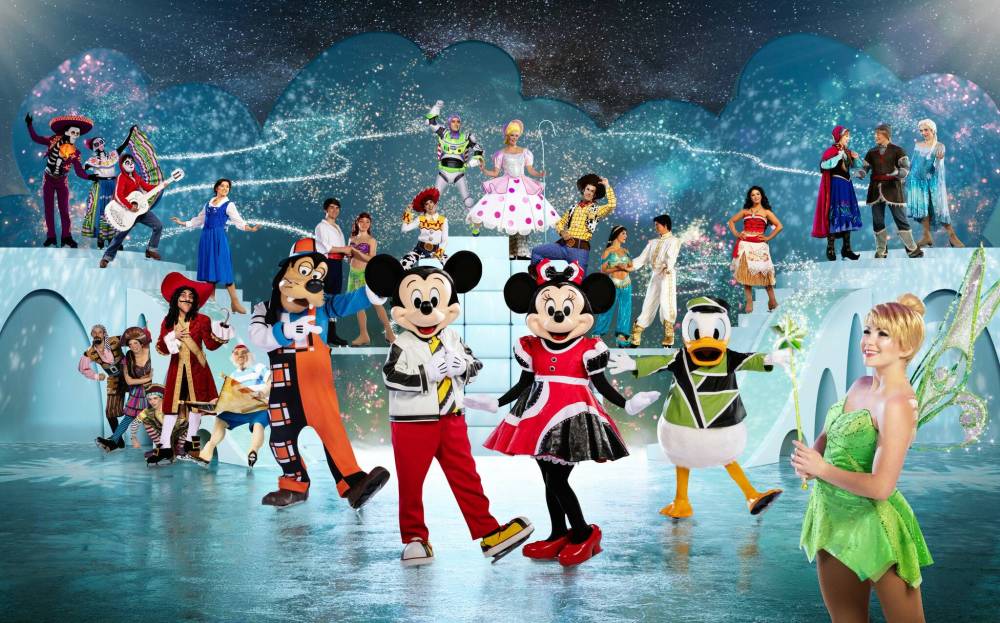
We have an ensemble who perform multiple roles within the show. I portray the role of Jessie from Toy Story, which is one of the segments in the show. I am also an aerialist in our Aladdin segment. Our show is really special because there are seven different stories and 11 different acrobatic elements throughout.
How many costume changes will you have in this show?
The number varies. You can have anywhere from four to eight or nine changes depending on the day and what you’re doing. I am in the opening number, and then I change to play Jessie then I have another costume change to be the aerialist in the Aladdin segment. Sometimes I am in Under the Sea as an anemone creature and then we have the finale.
Feld Entertainment
Mickey’s Search Party features seven different stories and 11 different acrobatic elements.
How long does it take?
Sometimes we do have very fast changes, and you have to change costumes in under two minutes. That’s just part of live entertainment. My costumes feel like a part of me; there’s always a very specific way I put them on. And I don’t have to take my skates off. We have a really awesome costume department and cosmetology team, and all of our costumes are handmade and specifically designed so we can put them on easily without taking our skates off.
How do you feel when you think about what you do for a living?
It feels now, after all these years, it feels normal. It feels like something I was always meant to do. I couldn’t imagine not living out of a suitcase and travelling all around the world performing.
What is the best thing about your job?
Being able to bring something that I love to families all over the world is really special to me. Growing up it didn’t really seem like that was a possibility. Especially being someone that came from a really small farm town — I never thought I could do something like this.

And what do you find challenging?
Definitely hard being away from home. I am very close to my family, and I love them very much. Because we are in Winnipeg this week, I actually get to fly home. I am going to visit them for a few days before I come back to work.
What skills other than skating do you need to do this job?
You need to have the ability to adapt to change. Things are constantly changing. Anywhere from where we are staying, to the venue layout, to how many days off we have to what the rehearsal schedule is like, every week is different and presents new challenges, new places and potentially new languages, so we are constantly adapting all the time. Being able to always have an open mind and go with the flow is a helpful trait to have in a job like this.
av.kitching@freepress.mb.ca
AV Kitching is an arts and life writer at the Free Press. She has been a journalist for more than two decades and has worked across three continents writing about people, travel, food, and fashion. Read more about AV.
Every piece of reporting AV produces is reviewed by an editing team before it is posted online or published in print — part of the Free Press‘s tradition, since 1872, of producing reliable independent journalism. Read more about Free Press’s history and mandate, and learn how our newsroom operates.
Our newsroom depends on a growing audience of readers to power our journalism. If you are not a paid reader, please consider becoming a subscriber.
Our newsroom depends on its audience of readers to power our journalism. Thank you for your support.
Event preview
Disney On Ice presents Mickey’s Search Party
Canada Life Centre
Friday to Sunday, various times
Tickets $27-$94 at Ticketmaster
AV Kitching is an arts and life writer at the Free Press. She has been a journalist for more than two decades and has worked across three continents writing about people, travel, food, and fashion. Read more about AV.
Every piece of reporting AV produces is reviewed by an editing team before it is posted online or published in print — part of the Free Press‘s tradition, since 1872, of producing reliable independent journalism. Read more about Free Press’s history and mandate, and learn how our newsroom operates.
Our newsroom depends on a growing audience of readers to power our journalism. If you are not a paid reader, please consider becoming a subscriber.
Our newsroom depends on its audience of readers to power our journalism. Thank you for your support.
Advertisement Advertise With Us
Advertisement Advertise With Us