

What is the responsibility of a national institution?
Advertisement
Read this article for free:
or
Already have an account? Log in here »
To continue reading, please subscribe:

Digital Subscription
One year of digital access for only $205*
- Enjoy unlimited reading on winnipegfreepress.com
- Read the E-Edition, our digital replica newspaper
- Access News Break, our award-winning app
- Play interactive puzzles
*First annual payment billed as $205.00 + GST for one year. This annual subscription will automatically renew at $233.00 + GST every 52 weeks (10% off the regular annual price of $259.35). Offer available to new and qualified returning subscribers only. Cancel any time.
To continue reading, please subscribe:
Add Free Press access to your Brandon Sun subscription for only an additional
$1 for the first 4 weeks*
- Enjoy unlimited reading on winnipegfreepress.com
- Read the E-Edition, our digital replica newspaper
- Access News Break, our award-winning app
- Play interactive puzzles
*Your next Brandon Sun subscription payment will increase by $1.00 and you will be charged $17.95 plus GST for four weeks. After four weeks, your payment will increase to $24.95 plus GST every four weeks.
Read unlimited articles for free today:
or
Already have an account? Log in here »
As we approach Canada Day, we reflect on the values that define our country: our way of life, our commitment to fairness, our responsibility to care for those in need and our collective obligation to contribute to a society built on respect, dialogue and shared responsibility.
Yet, as we celebrate these principles, we must also recognize troubling signs that some of our national institutions are failing to uphold the very commitments that make Canada unique. When institutions allow one-sided narratives, incomplete historical context and a lack of meaningful engagement to override reason, transparency and responsibility, they create a dangerous precedent.
There is perhaps no clearer example of this challenge than what has unfolded at the Canadian Museum for Human Rights (CMHR) with the opening of the controversial “Nakba” exhibition.
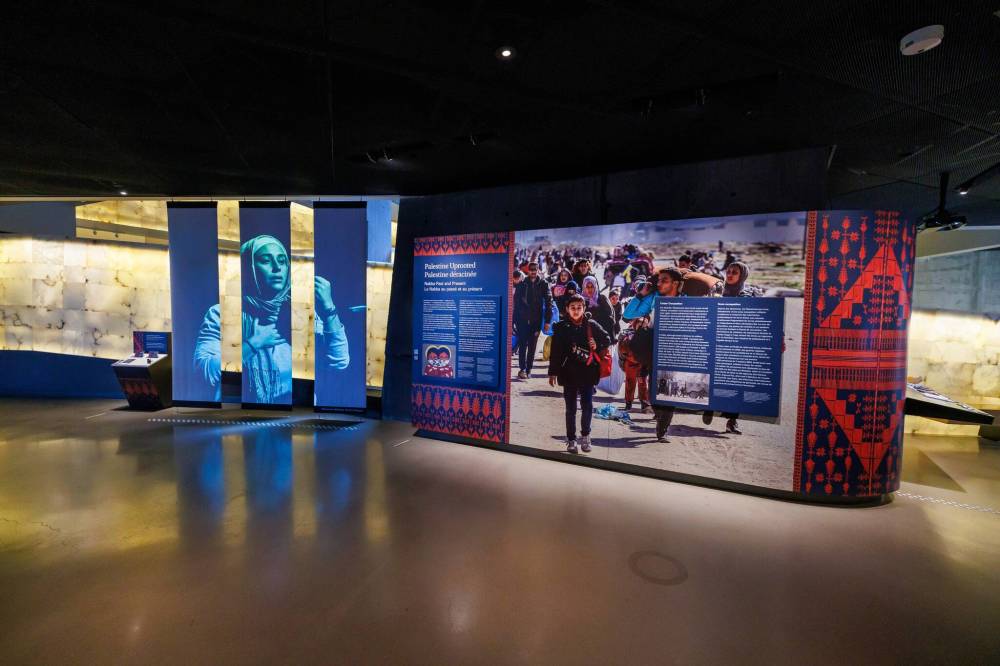
MIKE DEAL / FREE PRESS
The newly installed exhibition, Palestine Uprooted: Nakba Past and Present, at the Canadian Museum for Human Rights, has raised questions about the institution’s standards.
A national museum dedicated to human rights carries a profound moral responsibility. It must be grounded in intellectual rigour, historical integrity, transparency and balance. It must create space for difficult conversation while ensuring complex histories are presented with the depth, nuance and fairness Canadians expect of a national institution.
The concern is not simply about whether one story is being told. The deeper issue is the process that brought this exhibition forward: the decision-making, the consultation, the transparency and the responsibility of leadership to ensure that all affected communities were meaningfully engaged.
Now that the exhibition is publicly accessible, it is clear that our concerns were founded.
The selective presentation of narratives, the absence of meaningful consultation with communities directly affected, the lack of transparency surrounding the curatorial process and the limited historical context have raised serious questions about whether the museum has upheld the standards expected of a national institution.
Representatives of the Jewish community in Canada, along with other concerned voices, brought these issues forward to the museum’s leadership, its board and the federal government. One would expect that when the only Jewish board member of the museum resigns over concerns regarding a serious lack of transparency and an erosion of trust in the institution, the board would take notice.
When a past chair of the CMHR and the museum’s founding president raise concerns directly with current leadership, the board and the federal government, it signals that there are serious issues requiring examination.
When you sit on a board entrusted with public confidence, a national mandate and responsibility for a leading Canadian institution, you have an obligation to act in defence of that mandate and in service of the principles that define it.
Credible experts, historians, curators and human rights specialists were proposed as resources to help ensure a more balanced and rigorous approach. Those efforts were met without the meaningful engagement required.
This should not have been controversial. This should have been standard practice.
A national museum should welcome dialogue, especially when addressing painful and contested histories that impact multiple communities. The stories of Palestinians matter and deserve to be told. Presenting them should not exclude historical context and informed representation of the history of the region including the experiences, security concerns and trauma of Israelis and Jewish communities. A responsible institution must have the courage and integrity to acknowledge complexity rather than reduce history to a single narrative.
Had the leadership of the museum engaged in genuine dialogue and embraced a process rooted in transparency and intellectual honesty, Canada could have witnessed an exhibition that met the highest standards expected from a national institution — one that challenged Canadians, educated Canadians and brought people together.
That is what Canadians expect from their institutions: institutions that build rather than divide, that consult rather than dismiss and that seek understanding rather than reinforce division.

The question now is where we go from here.
Canada Day is not a moment to turn away from these challenges. It is precisely when we must recommit ourselves to protecting the institutions that serve our democracy and our shared values. When citizens disengage, political interests and ideological agendas can fill the space, eroding trust and further dividing communities.
Our institutions matter. They are meant to preserve truth, encourage dialogue and strengthen the social fabric that holds Canada together.
On this Canada Day, our responsibility is not only to celebrate what Canada is, but to defend what Canada must continue to be.
Gustavo Zentner is vice-president of the Manitoba and Saskatchewan Centre for Israel and Jewish Affairs (CIJA)
Related Articles
Palestinian Canadians share keepsakes, memories in CMHR's Nakba exhibition







Advertisement Advertise With Us
Advertisement Advertise With Us