Treat winter asthma in summer? Qi whiz!
Advertisement
Read this article for free:
or
Already have an account? Log in here »
To continue reading, please subscribe:

Digital Subscription
One year of digital access for only $205*
- Enjoy unlimited reading on winnipegfreepress.com
- Read the E-Edition, our digital replica newspaper
- Access News Break, our award-winning app
- Play interactive puzzles
*First annual payment billed as $205.00 + GST for one year. This annual subscription will automatically renew at $233.00 + GST every 52 weeks (10% off the regular annual price of $259.35). Offer available to new and qualified returning subscribers only. Cancel any time.
To continue reading, please subscribe:
Add Free Press access to your Brandon Sun subscription for only an additional
$1 for the first 4 weeks*
- Enjoy unlimited reading on winnipegfreepress.com
- Read the E-Edition, our digital replica newspaper
- Access News Break, our award-winning app
- Play interactive puzzles
*Your next Brandon Sun subscription payment will increase by $1.00 and you will be charged $17.95 plus GST for four weeks. After four weeks, your payment will increase to $24.95 plus GST every four weeks.
Read unlimited articles for free today:
or
Already have an account? Log in here »
Hey there, time traveller!
This article was published 09/07/2009 (6281 days ago), so information in it may no longer be current.
Remember the fable about the grasshopper and the ant?
The ant uses the hottest days of the year to prepare for the hardships of the coming winter, while the grasshopper dances and plays the summer away.
In our part of the world, the latter’s seasonal amnesia makes perfect sense. How else to survive a Manitoba winter other than to let its frigid memories melt away with the ice and snow?
In China, however, the dog days of summer are considered a prime time for preventing winter health problems — particularly those that make inhaling blasts of cold air even more painful, such as asthma.
While we’re lining up at ice cream stands and outdoor patios, thousands of Chinese people are queuing inside hospitals and acupuncture clinics to receive treatments that draw on centuries of healing wisdom.
In Traditional Chinese Medicine (TCM), it’s the ancient practice of dong bing xia zhi — literally, treating winter ailments in summertime — and it’s now being offered in Winnipeg.
If you’re an asthma sufferer whose condition worsens in the cold months, the Eastern Healing Centre (1036 Portage Ave.) invites you to consider nourishing your "yang" this summer rather than just loading up on drugs and inhalers next winter.
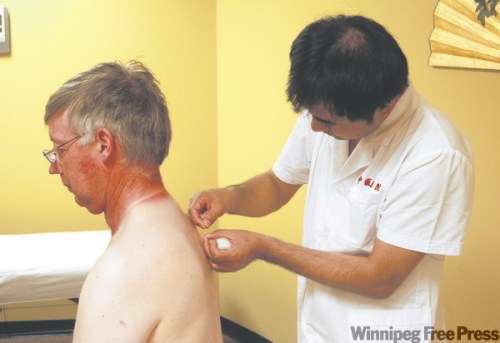
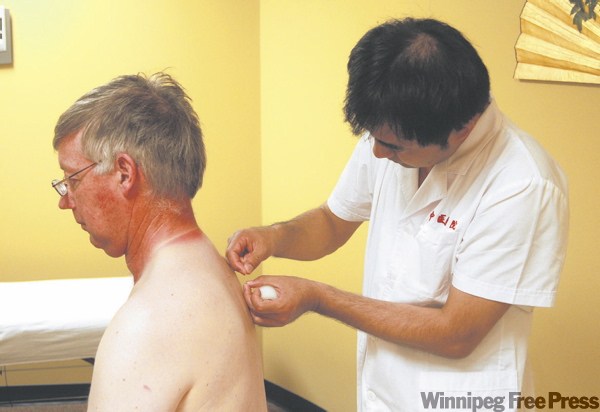
As in China, the treatment requires patients to come to the clinic on the three hottest days of summer, according to the Chinese almanac. (This year there are four days: July 14 and 24 and Aug. 3 and 13). On each of those days, between 10 and 15 tiny acupuncture needles (around three millimetres long) will be inserted into specific spots on your chest and back, where they’ll remain for 24 hours. The needles get taped in place, so you can go about your day as usual.
It’s not a quick fix. "Some people will get better after the first treatment, but we usually suggest they come back every year for three years," says Lin Liu, a fourth-generation TCM doctor who runs the Portage Avenue clinic.
Asthma, which afflicts 300 million people around the world (about three million in Canada), is a chronic lung disease that inflames and narrows the airways and is characterized by recurrent bouts of breathlessness and wheezing. The exact cause is not known. In the West, doctors generally prescribe inhaled corticosteroids to reduce swelling and narrowing in the airways.
"Inhalers mask the symptoms," Liu says. "TCM is slower, but it’s healing the whole body."
According to TCM, all movement and function in the body is the result of a universal energy called qi (pronounced chee), which is transported throughout the body via 12 main energetic pathways, or meridians.
Also, opposing but complementary forces called yin and yang — eg. dark/light, feminine/masculine, cold/hot — are constantly in motion to create balance in the body.
Disease occurs when the flow of qi is blocked or becomes stagnant, either through physical, emotional or environmental factors (including seasonal changes), resulting in relative excess or deficiency of yin or yang.
Asthmatics whose symptoms worsen in winter are said to have the cold type of asthma — meaning there’s an excess of yin. So treating it with cold-expelling therapies during summer’s dog days, when yang energy peaks, is said to prevent relapses in winter.
Acupuncture stimulates the flow of qi by inserting needles into specific points on the energy meridians.
"Each point is like a little door that you can open to let the heat in," says Liu.
In China, in addition to acupuncture, the asthma treatment also used herbal plasters applied to the acu-points and moxibustion, an ancient form of heat therapy that involves burning the herb mugwort.
"At my hospital, hundreds of would come and wait in line from six in the morning until late in the evening on asthma days," says Dr. Zhaocheng Han, a TCM doctor who joined the Eastern Healing Centre team last year from Shandong Province.
The cost of all four asthma treatments is $180. An initial consultation/diagnosis is required. For more information, call 284-4047.
carolin.vesely@freepress.mb.ca