Manitoba First Nations get $19 million to fight diabetes

Advertisement

Advertise with us

Ottawa will pump $19 million over the next four years to combat the province's soaring diabetes epidemic on First Nations under a new health care deal that will focus on foot care.

Read this article for free:


or

Already have an account? Log in here »

To continue reading, please subscribe:

Subscribe and receive a limited-edition Free Press branded hat or tote.

Digital Subscription

One year of digital access for only $205*

  • Enjoy unlimited reading on winnipegfreepress.com
  • Read the E-Edition, our digital replica newspaper
  • Access News Break, our award-winning app
  • Play interactive puzzles

*First annual payment billed as $205.00 + GST for one year. This annual subscription will automatically renew at $233.00 + GST every 52 weeks (10% off the regular annual price of $259.35). Offer available to new and qualified returning subscribers only. Cancel any time.

To continue reading, please subscribe:

Add Free Press access to your Brandon Sun subscription for only an additional

$1 for the first 4 weeks*

  • Enjoy unlimited reading on winnipegfreepress.com
  • Read the E-Edition, our digital replica newspaper
  • Access News Break, our award-winning app
  • Play interactive puzzles
Start now

*Your next Brandon Sun subscription payment will increase by $1.00 and you will be charged $17.95 plus GST for four weeks. After four weeks, your payment will increase to $24.95 plus GST every four weeks.

Hey there, time traveller!
This article was published 19/09/2017 (3287 days ago), so information in it may no longer be current.

Ottawa will pump $19 million over the next four years to combat the province’s soaring diabetes epidemic on First Nations under a new health care deal that will focus on foot care.

Health Canada approved the funding and the lead Manitoba agency, Nanaandawewigamig, the First Nations Health and Social Secretariat of Manitoba, announced it in Portage la Prairie Tuesday.

It is believed to be the first ever regional program designed for and delivered by Indigenous people in their own communities to stem rising rates of amputation, one of the most tragic complications of diabetes

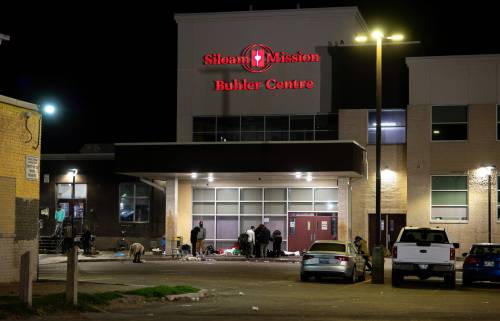
WAYNE GLOWACKI / WINNIPEG FREE PRESS FILES
A podiatry room in the Saul Sair Health Centre in the Siloam Mission.
WAYNE GLOWACKI / WINNIPEG FREE PRESS FILES A podiatry room in the Saul Sair Health Centre in the Siloam Mission.

“We recognized the need and we have been working on obtaining funding to support these services for nearly 20 years,” said Pimicikamak Chief Catherine Merrick, Nanaandawewigamig board chair, in a statement Tuesday.

The funding allows Manitoba First Nations to follow through with standing recommendations for care from Diabetes Canada, formerly known as the Canadian Diabetes Association.

The announcement was made at the Nanaandawewigamig annual general meeting on the Long Plains urban reserve in Portage la Prairie.

Rates of diabetes are three to five times higher for Indigenous Canadians compared to the general population. On some First Nations, 26 per cent of residents have been diagnosed with Type 2 diabetes.

In Manitoba, diabetes affects roughly one in five (18.9 per cent) First Nations people, compared to 4.5 per cent of the rest of the population. First Nations people are also 18 times more likely to have an diabetes related amputation.

Without strategic intervention, treating diabetes is expected to rise nearly 30 per cent to $639 million by 2020, according to figures released with the funding announcement.

With proper foot care, an estimated 85 per cent of amputations are thought to be preventable.

We are pleased that (Ottawa) is investing in a preventative approach which will support the the reduction of further complications. . .,” said Keewatin Tribal Council nursing officer Anita Crate, who co-chaired efforts to secure funding.

Noting that foot care is an insured service in British Columbia and Alberta but not in Manitoba, Crate urged the province to take a second look at the impact of diabetes on the rest of the province.

“The province of Manitoba should strongly consider this as an insured service for all Manitobans who have diabetes. It’s invest now or pay later with more costly services such as physician billing, surgical costs, hospitalizations, rehab services and so forth,” Crate warned.

Ottawa has funded diabetic foot care programs here in the past, but never more than a few hundred thousand dollars a year, funnelled through the University of Manitoba’s Northern Medical Unit, which Ottawa uses to supply fly-in doctors to the north.

With the announcement, Ottawa made the funding available for the first time through a First Nations-run agency. Nanaandawewigamig will work directly with Manitoba tribal councils to provide the services. First Nations that aren’t aligned with tribal councils will be provided with their own funding. There was no word on the date services would be rolled out.

The multimillion funding allows First Nations their first ever opportunity to collaborate meaningfully with the province to create a system of seamless diabetes and kidney health care on First Nations with limited access to doctors.

In 2016, health-care experts with the secretariat asked Ottawa for more than $19 million over four years for diabetes-related foot-care clinics in all of Manitoba’s 60-plus First Nations communities. This past summer, federal health-care officials and First Nations diabetes advocates met over two days to set up a plan to roll out services.

Until now, nine Manitoba First Nations had advanced programs in this specialized area, 21 others have basic services and the rest — 34 communities, mostly in the north — have no services.

alexandra.paul@freepress.mb.ca
Report Error Submit a Tip

More Stories

A life’s story: activist, educator, organizer knew the true meaning of community

Janine LeGal 7 minute read Preview

A life’s story: activist, educator, organizer knew the true meaning of community

Janine LeGal 7 minute read 3:00 AM CDT

Somewhere between a love for sharing stories and a love of community connections, Michael (Mike) Maunder lived his life. Giving voice to people and neighbourhoods was a passion for the natural-born community organizer.

An author, teacher and principal, Maunder lived in a one-bedroom apartment in West Broadway and devoted himself to community development, education and neighbourhood renewal.

He maintained a connection with Augustine United Church, whose commitment to social justice he appreciated, volunteered at the Sandy-Saulteaux Spiritual Centre, and found comfort in a Buddhist prayer community.

Maunder died on July 15 at the age of 80.

Read
3:00 AM CDT

Canada must not accept another Iranian autocracy

David Matas 5 minute read 2:01 AM CDT

Iran is a state run by a radical government victimizing its citizens and its neighbours. How do we change that? Any regime change that repeats the mistakes of the past is not a solution.

What went wrong in the past which led to the current regime? One answer is the U.K. and American aided coup which led to the ouster in 1953 of a democratically elected government headed at the time by Mohammad Mossadegh and its replacement with an American friendly autocrat, the Shah of Iran, Mohammad Reza Pahlavi.

The Shah imposed his rule through the Iranian National Intelligence and Security Organization — SAVAK, the acronym of its Persian name. SAVAK systematically inflicted torture, arbitrary killings and extra-judicial killings on perceived opponents of the regime. It was only a matter of time before repression of a regime directed to serving foreign interests would be overthrown.

What replaced the regime of the Shah, in 1979, the current regime of the mullahs, is a regime as intolerant and violent as the regime of the Shah and then some. That was not inevitable. But neither was it surprising. The vicious nature of the current regime, following the example set by the Shah, and its hatred for the United States, reacting to the U.S. aided imposition of the Shah, both echoes and reacts to the past. In 1979, the U.S. reaped what it sowed in 1953.

Siloam Mission, WFPS discussing on-site paramedic to reduce staggering number of emergency calls

Scott Billeck 4 minute read Preview

Siloam Mission, WFPS discussing on-site paramedic to reduce staggering number of emergency calls

Scott Billeck 4 minute read Yesterday at 2:00 AM CDT

Winnipeg’s fire-paramedic service and its largest homeless-serving organization are discussing what it would look like to station at least one paramedic at Siloam Mission, as emergency calls to the downtown facility surge.

The ongoing discussions come as Winnipeg Fire Paramedic Service crews were dispatched 1,771 times during the first eight months of the year to the two adjacent Siloam properties at 303 Stanley St. and 300 Princess St.

WFPS said most of the calls were related to overdoses or other consequences of substance use, with the total nearly double the 854 calls recorded over the same period last year. By comparison, there were 831 calls during the same span in 2024, and 591 in 2023.

“The number of emergency calls isn’t sustainable for us as a service, but it’s certainly not sustainable for them as an agency trying to provide services,” WFPS chief Ryan Sneath told the Free Press. “And they recognize that they’re impacting emergency services, not them specifically, but the site in a significant way.”

Read
Yesterday at 2:00 AM CDT

Give-and-take relationship of Roman leaders takes centre stage in Harris’s historical fiction

Reviewed by Kathryne Cardwell 4 minute read Preview

Give-and-take relationship of Roman leaders takes centre stage in Harris’s historical fiction

Reviewed by Kathryne Cardwell 4 minute read 2:01 AM CDT

British novelist Robert Harris’s latest work is a reflection on tyranny, corruption and betrayal among all-powerful political leaders.

You might be forgiven for thinking it’s a contemporary thriller — it’s actually historical fiction set in ancient Rome.

A former BBC journalist, Harris debuted as a novelist in 1992 with Fatherland, an alternative history where Nazi Germany won the Second World War.

Since then, the prolific author has become best-known for his works of historical fiction, especially his ancient Rome trilogy released from 2006-2015 and the novel Conclave, which was published in 2016 and was made into the film of the same name in 2024.

Read
2:01 AM CDT

American Hostage stars recall warmth of Winnipeggers during brutal winter

Randall King 7 minute read Preview

American Hostage stars recall warmth of Winnipeggers during brutal winter

Randall King 7 minute read Yesterday at 6:13 PM CDT

TORONTO — When you stream the eight-part series American Hostage, a sense of familiarity may strike.

That’s because the show was shot in Winnipeg — especially in the Exchange District — from November of last year to the beginning of February, with Winnipeg portraying Indianapolis circa 1977.

The whole world seemed to be watching that midwest American city that year as a hostage crisis unfolded involving one Tony Kiritsis, an angry man who goes ballistic when a mortgage brokerage was poised to foreclose on property he had dreamed of developing into a shopping centre.

Kiritsis kidnapped his mortgage broker, Richard Hall, wiring a shotgun to the back of his head, and demanded a public airing of his grievances, with the reluctant help of popular radio broadcaster Fred Heckman.

Read
Yesterday at 6:13 PM CDT

Kinew delivered what most of us wanted; now we’ll have to deal with the consequences

Dan Lett 5 minute read Preview

Kinew delivered what most of us wanted; now we’ll have to deal with the consequences

Dan Lett 5 minute read Updated: Yesterday at 8:43 AM CDT

Premier Wab Kinew has decided to adopt permanent daylight savings time, which means a permanent end to the spring forward, fall back tradition of adjusting our clocks. And absolutely no one is surprised.

Read
Updated: Yesterday at 8:43 AM CDT