Cognitive Psychology

Please review each article prior to use: grade-level applicability and curricular alignment might not be obvious from the headline alone.

Gov. Gen. Simon launches mental health project for North, Indigenous communities

Sarah Ritchie, The Canadian Press 2 minute read Preview

Gov. Gen. Simon launches mental health project for North, Indigenous communities

Sarah Ritchie, The Canadian Press 2 minute read Saturday, May. 30, 2026

OTTAWA - Outgoing Gov. Gen. Mary Simon has launched a project to fund community-based mental health services in Northern and Indigenous communities.

The legacy project will be run with support from the Rideau Hall Foundation.

It is called Ajuinnata, an Inuktitut word that means "never give up." The project will begin in Inuit Nunangat.

Simon launched a mental health learning and listening tour in 2024 as one of her priorities in the viceregal office. She said the people she met made it clear the shortage of stable services in the North is an acute problem.

Read
Saturday, May. 30, 2026

You should be dancing, yeah. Moving to music offers all kinds of benefits as you age

Anita Snow, The Associated Press 5 minute read Preview

You should be dancing, yeah. Moving to music offers all kinds of benefits as you age

Anita Snow, The Associated Press 5 minute read Tuesday, Jun. 2, 2026

TUCSON, Ariz. (AP) — Carol Ross can’t stop smiling at dance practice as she shouts out the steps of a routine to members of her tap and jazz troupe for women age 50 and older.

“I’ve been dancing my whole life, it’s the best,” said Ross, who founded the Rodeo City Wreckettes group 23 years ago at an age when many people are getting ready for retirement.

Now 87, Ross and her husband and lifelong dance partner John, also 87, have long known what more older adults are now discovering: Moving to music is one of the best ways to stay healthy. Medical professionals say it doesn’t matter if it’s Western line dancing, ballroom steps, salsa, tap, Zumba at the gym, or with a group like the Wreckettes.

“Dancing is one of the most powerful activities for older people,” said Julio Loya, a nurse and geriatric program coordinator at the Tucson Medical Center.

Read
Tuesday, Jun. 2, 2026
No Subscription Required

Religious groups must keep careful eye on artificial intelligence

John Longhurst 5 minute read Saturday, May. 23, 2026

Programmers, computer scientists and software, mechanical, data and prompt engineers — these are some of the professions behind the creation of artificial intelligence. Should theologians and faith leaders also be involved?

Meghan Sullivan, a Roman Catholic who teaches philosophy at the University of Notre Dame, says yes. That’s why she was glad to attend a meeting in March at the invitation of Anthropic, the creator of Claude AI, about the role religion can play in the creation of this life-changing technology.

Sullivan, who also directs the university’s Institute for Ethics and the Common Good, was there with 15 other Christian philosophers, theologians and leaders to discuss the implications of AI for society today — and how it can be taught to behave ethically and morally using religion as a guide.

I spoke with Sullivan this week about that meeting. “I’m very grateful for Anthropic’s leadership in this area with faith communities,” she said, noting that most AI companies are not doing that. “It should have happened sooner, but better late than never.”

Music as therapy — singing through tears

Pam Frampton 5 minute read Preview

Music as therapy — singing through tears

Pam Frampton 5 minute read Wednesday, May. 20, 2026

It’s Sunday and I arrive in the middle of hymn sing. Mom and her roommate are dozing on the couch in the lobby as the songs swell around them, the recorded music supplemented by a choir of earnest voices.

The diminutive lady with the horn-rimmed glasses who had vigorously belted out Nancy Sinatra’s These Boots Are Made for Walkin’ at last week’s singalong is more subdued today, her voice soft and plaintive during Why Me Lord?

Indeed, there is an air of sadness to this gathering, the musical selections steeped in nostalgia. It feels more like group therapy than joyful noise.

But then the residents here are grieving. They have lost two of their number in recent weeks, both wonderful women whose company I enjoyed on many previous visits, and today’s music session has been dedicated to their memories.

Read
Wednesday, May. 20, 2026

More time at work is not always more productive work

Tory McNally 5 minute read Preview

More time at work is not always more productive work

Tory McNally 5 minute read Saturday, May. 2, 2026

Canada’s productivity conversation has increasingly focused on a simple but important measure: output per hour worked. In other words, what are we actually producing for the time we are putting in?

Read
Saturday, May. 2, 2026
No Subscription Required

Motherless Day embraces those grieving parental loss

AV Kitching 6 minute read Preview
No Subscription Required

Motherless Day embraces those grieving parental loss

AV Kitching 6 minute read Saturday, Apr. 25, 2026

There’s a collage in Katrina Zborowsky’s bedroom that is greater than the sum of its parts. The collection of fragments is tangible evidence that Zborowsky, 32, has successfully navigated yet another Mother’s Day after the loss of her mother Doris, 57, in a cycling accident in September 2020.

Read
Saturday, Apr. 25, 2026

Brainstorming session proposes solutions to alarming rate of student absenteeism

Maggie Macintosh 6 minute read Preview

Brainstorming session proposes solutions to alarming rate of student absenteeism

Maggie Macintosh 6 minute read Thursday, Apr. 23, 2026

Dante Taylor spent much of his early high school career ditching class — a routine occurrence outside of football season — to hang out at trap houses in Winnipeg.

“For so long, I just didn’t care,” the 16-year-old told an auditorium packed with 200 people, many of them principals and superintendents, at a summit on student absenteeism.

“It wasn’t something that seemed to be important to me because it didn’t seem to be important to anybody that I was around.”

Dante said his perspective changed recently, after meeting with a guidance counsellor, doing extensive self-reflection and enrolling in a physics course that he finds equally fascinating and challenging.

Read
Thursday, Apr. 23, 2026

Supervised drug consumption site will be grounded in culture, compassion: facility’s leader

Scott Billeck 7 minute read Preview

Supervised drug consumption site will be grounded in culture, compassion: facility’s leader

Scott Billeck 7 minute read Friday, Apr. 17, 2026

Winnipeg’s first supervised consumption site is being designed as a culturally grounded health space where people struggling with addiction will be met with familiarity, dignity and support from the moment they enter.

Read
Friday, Apr. 17, 2026

Years of training keep Artemis II crew mission-ready, researcher says

Sidhartha Banerjee, The Canadian Press 4 minute read Preview

Years of training keep Artemis II crew mission-ready, researcher says

Sidhartha Banerjee, The Canadian Press 4 minute read Sunday, Mar. 22, 2026

MONTREAL - Despite the delays for NASA's Artemis II mission around the moon and back, a space medicine researcher says the crew, which includes Canadian astronaut Jeremy Hansen, are physically ready for when the time comes to launch.

"They've been preparing for years, so what is a few more months," said Dr. Farhan Asrar, a physician, space medicine researcher and associate dean at Toronto Metropolitan University's School of Medicine.

"One thing that I've always kind of appreciated and respected in the life of astronauts … is it's always expecting the unexpected and how do you best prepare for that?"

NASA has targeted an April 1 launch for Artemis II, with a six-day launch window running through April 6 announced last week.

Read
Sunday, Mar. 22, 2026

Senior squeeze: Many older Manitobans are in an increasingly precarious financial situation

Janine LeGal 14 minute read Preview

Senior squeeze: Many older Manitobans are in an increasingly precarious financial situation

Janine LeGal 14 minute read Friday, Mar. 13, 2026

Terisa Taylor is deemed a low-income senior, based on the federal tax bracket classification, but the numbers don’t take a full measure of the person.

At age 73, the St. Boniface resident relies on the three acronyms synonymous with aging — CPP, GIS and OAS — to make ends meet.

Manitoba Rental Assistance helps cover about half her apartment costs, but she gave up her car when it became clear it was no longer affordable.

Despite that, Taylor considers herself one of Manitoba’s more fortunate seniors since she’s able to continue to pursue a meaningful life.

Read
Friday, Mar. 13, 2026

AI chatbots and teens — a sometimes deadly combination

Editorial 4 minute read Preview

AI chatbots and teens — a sometimes deadly combination

Editorial 4 minute read Wednesday, Feb. 25, 2026

As if there weren’t enough concerns about the changes artificial intelligence may bring in the future — the displacement of millions of workers, or the potential for AI to disconnect from its human managers and go its own way — there are clear and present dangers which AI companies must be forced to address now.

Read
Wednesday, Feb. 25, 2026

Generalizations and facts

Mac Horsburgh 4 minute read Wednesday, Feb. 25, 2026

Recently, I ran across a social media post with 100,000 followers which stated that “the media is the communist arm of the government.”

At first blush, it is easy to write off an outlandish comment like this as a function of a neurodegenerative illness or a psychological disorder.

Certainly, as a middle-of-the-road regular contributor to articles on the Think Tank page, I have never thought of myself as a communist. Truth be told, the Free Press neither offers me direction about what I write, nor do they pay me for my op-ed pieces. A post like this also does a grave disservice to the many dedicated journalists who ply their trade according to strict ethical guidelines.

At the same time, however, I realize that there are people who don’t read the Free Press because they believe that the mainstream media (MSM) have been co-opted and corrupted by government subsidies.
Police warn about AI use in sophisticated scam calls

Chris Kitching 3 minute read Preview

Police warn about AI use in sophisticated scam calls

Chris Kitching 3 minute read Wednesday, Feb. 25, 2026

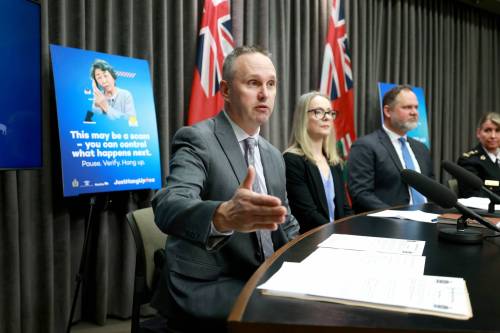
Police warned Manitobans about the rising use of artificial intelligence to clone voices for use in phone scams, while launching a campaign Tuesday to protect seniors from fraud.

The six-month “Just Hang Up” campaign will alert seniors, their children and their caregivers about grandparent or emergency scams that have become prevalent and increasingly sophisticated.

“These scams are designed to be high pressure. They prey on the ones we love the most — our grandparents, the ones we know who are going to help us in the time of need,” Winnipeg Police Service Insp. Jennifer McKinnon said at a news conference.

Manitobans aged 60 and older reported losing almost $350,000 to grandparent or emergency scams in 2024, as reported by the Canadian Anti-Fraud Centre. The actual total is likely much higher because scams are vastly underreported.

Read
Wednesday, Feb. 25, 2026

Attention-grabbing screens demean us, bit by bit

Melissa Martin 8 minute read Preview

Attention-grabbing screens demean us, bit by bit

Melissa Martin 8 minute read Saturday, Jan. 3, 2026

The first time I read Oryx and Crake, Canadian author Margaret Atwood’s haunting dystopic novel, I couldn’t put it down. I devoured it in just days, engrossed by the fictional world Atwood wove from the most discomfiting new threads of our own.

Over the years, I returned to the book many times, always finding new depth in its pages. Each time, I finished it at the same brisk pace. I was a fast reader as a child, and for most of my life, that didn’t change.

Until now. In November, as part of an effort to calm my restless mind, I put Oryx and Crake on my nightstand, and made a pledge to myself to read a little bit every night. This time, it’s been over two months, and I’ve made it through only 92 pages.

It would be easy to say I’ve been too busy, but that would be a lie. I’ve had time to read. The problem is now, unlike when the book came out in 2003, I struggle to read more than a page without checking my phone quickly; and checking it once means falling into the chasm of raw content the internet has become.

Read
Saturday, Jan. 3, 2026

Disconnect from digital, embrace an analogue life

Jen Zoratti 5 minute read Saturday, Jan. 3, 2026

It looks like 2026 is already shaping up to be the year of the analogue.

All over Instagram I’ve seen posts deriding, well, spending all your time on Instagram. People are setting intentions to listen to, read and watch physical media, pick up tactile hobbies such as painting, knitting, collaging and crocheting and buying alarm clocks and timers.

Screen time is out. Reconnecting with real life is in.

Over on TikTok, creators are encouraging people to pack an “analogue bag,” which is just a TikTok trendspeak for “sack of activities.” You can put whatever you want in there, but suggestions include books, journals, puzzles and sketchpads — things that do not require an internet connection or a phone.

On virtue and vice signalling

Mac Horsburgh 4 minute read Saturday, Jan. 3, 2026

I don’t know which is worse: virtue or vice signalling.

U.S. President Donald Trump is the consummate vice signaller who ostentatiously targets any group or issue he thinks will help him retain political power. Vice signalling is a form of rage farming that promotes controversial views which appear to be tough-minded, uncompromising and authoritarian.

During his second term, Trump has set his sights on immigrants, government employees, medical science, women’s rights, transgender athletes, crime and countries like Venezuela.

And if nothing else, Trump knows his audience.

Province hunting for web-based system to better assess and help youth with mental-health, addiction issues

Carol Sanders 3 minute read Preview

Province hunting for web-based system to better assess and help youth with mental-health, addiction issues

Carol Sanders 3 minute read Friday, Jan. 2, 2026

As a drug crisis rages in Manitoba, the province is looking for a better web-based mental-health and addictions assessment tool for youth to help connect them to the services they need.

Shared Health said it’s seeking an evidence-based assessment system that focuses on mental health and substance use challenges in youth. On Monday, it posted on the public-sector tendering site MERX that it’s looking for systems and tools that are secure and ready to go.

A spokesperson for Shared Health said the authority is trying to determine whether there are any stronger screening tools and digital platforms than what is currently in use. The Manitoba Advocate for Children and Youth has sounded the alarm over substance use among children and youth, and the need for the province to do more and better.

Shared Health currently has a screening tool and digital platform — the Child Behavior Checklist and the Achenbach System of Empirically Based Assessment (ASEBA-Web), the spokesperson said.

Read
Friday, Jan. 2, 2026

Fewer than one in five Manitobans are sure they know fabricated online content when they see it: survey

Ben Waldman 5 minute read Preview

Fewer than one in five Manitobans are sure they know fabricated online content when they see it: survey

Ben Waldman 5 minute read Tuesday, Jan. 6, 2026

When Weekly World News stories about a half-boy, half-bat lined supermarket checkout lanes in the 1990s, most consumers — including Probe Research partner Curtis Brown — could readily, easily and confidently identify the eye-grabbing tabloid reports as false.

“When it comes to (content generated by) AI, people have a bit less confidence,” says Brown. “Sometimes it’s very obviously so-called AI slop — like a historical figure talking about something contemporary. The last couple of months I’ve seen a lot of videos of JFK talking about what a fool his nephew is.”

Even if a quick Google search to note RFK Jr. was nine when his uncle was assassinated in 1963 — marking such videos as debris in an artificial intelligence mudslide — new media literacy polling conducted by Probe for the Free Press reveals that only 18 per cent of Manitobans feel very confident that they can identify whether video footage is “fake or AI-generated.”

Of the 1,000 Manitobans randomly surveyed by Probe between Nov. 25 and Dec. 10, 13 per cent believed that they’d personally shared video, images or text on social media that they didn’t realize was fake.

Read
Tuesday, Jan. 6, 2026

Regulators up surveillance of ‘gamification’ techniques used to game investors (potentially) of their money

Joel Schlesinger 5 minute read Preview

Regulators up surveillance of ‘gamification’ techniques used to game investors (potentially) of their money

Joel Schlesinger 5 minute read Saturday, Dec. 13, 2025

Fun and games aren’t just for children this holiday season. Turns out, investing is increasingly gamified.

However, it’s more of a year-round thing, as online investment platforms use “gamification” techniques, which can make the business of dollars and cents a little more fun.

In essence, gamification involves leveraging powerful behavioural psychology tools that nudge, through video game-like design, consumers toward engaging in certain behaviours — for better and for worse.

Canada’s largest investment regulator — the Ontario Securities Commission — has conducted a few studies examining gamification to understand its potential for benefiting and harming investors.

Read
Saturday, Dec. 13, 2025

Open AI, Microsoft face lawsuit over ChatGPT’s alleged role in Connecticut murder-suicide

Dave Collins, Matt O'brien And Barbara Ortutay, The Associated Press 6 minute read Preview

Open AI, Microsoft face lawsuit over ChatGPT’s alleged role in Connecticut murder-suicide

Dave Collins, Matt O'brien And Barbara Ortutay, The Associated Press 6 minute read Saturday, Dec. 13, 2025

SAN FRANCISCO (AP) — The heirs of an 83-year-old Connecticut woman are suing ChatGPT maker OpenAI and its business partner Microsoft for wrongful death, alleging that the artificial intelligence chatbot intensified her son's “paranoid delusions” and helped direct them at his mother before he killed her.

Police said Stein-Erik Soelberg, 56, a former tech industry worker, fatally beat and strangled his mother, Suzanne Adams, and killed himself in early August at the home where they both lived in Greenwich, Connecticut.

The lawsuit filed by Adams' estate on Thursday in California Superior Court in San Francisco alleges OpenAI “designed and distributed a defective product that validated a user’s paranoid delusions about his own mother.” It is one of a growing number of wrongful death legal actions against AI chatbot makers across the country.

“Throughout these conversations, ChatGPT reinforced a single, dangerous message: Stein-Erik could trust no one in his life — except ChatGPT itself," the lawsuit says. “It fostered his emotional dependence while systematically painting the people around him as enemies. It told him his mother was surveilling him. It told him delivery drivers, retail employees, police officers, and even friends were agents working against him. It told him that names on soda cans were threats from his ‘adversary circle.’”

Read
Saturday, Dec. 13, 2025
No Subscription Required

Local Buddhist Temple teaches true meaning of karma; promotes positive living

John Longhurst 4 minute read Preview
No Subscription Required

Local Buddhist Temple teaches true meaning of karma; promotes positive living

John Longhurst 4 minute read Thursday, Oct. 23, 2025

A popular misconception about the Buddhist idea of karma is that it’s about punishment — a kind of cosmic “what goes around comes around.”

While Buddhists believe actions have consequences, karma is a much deeper idea than that, said Kyle Rathgaber, a board member of the Manitoba Buddhist Temple.

“Karma is not about retribution,” he said. “It’s not about being punished for something you did wrong.”

While there are elements of negative consequences in the idea of karma — if you are angry at others all the time, you may feel stress and anxiety in your own life — for Rathgaber, 34, it’s more about how people can peacefully and helpfully engage the world around them.

Read
Thursday, Oct. 23, 2025

Being human — by choice

Carina Blumgrund 5 minute read Wednesday, Oct. 22, 2025

I have found myself thinking about what draws me to a children’s television host who spent decades talking about how we live together in neighbourhoods.

Fred Rogers had this gentle way of speaking to children about the everyday challenges of being human: how to handle anger, disappointment, fear, and joy. But the more I consider his approach, the more I realize he wasn’t really teaching children how to behave, how to feel about themselves, how to understand the world around them. He was making something much more fundamental feel possible and worthwhile: he was making human decency aspirational.

Mr. Rogers knew that how we treat each other matters, not because it’s polite or proper, but because it’s how we create the kind of world we actually want to live in. His genius wasn’t in the specific lessons he taught, but in how he made kindness, patience, honesty, and gentleness feel like the most essential ways to be human.

I keep wondering if that’s what we’re missing sometimes. Not more rules about how to behave, but a sense that kindness and integrity are worth striving for.

Police investigating fires, vandalism at NDP cabinet ministers’ North End constituency offices

Malak Abas 4 minute read Preview

Police investigating fires, vandalism at NDP cabinet ministers’ North End constituency offices

Malak Abas 4 minute read Tuesday, Sep. 23, 2025

Broken windows, four blazes started in two months

Read
Tuesday, Sep. 23, 2025

Stop the online world, I want to get off

Russell Wangersky 5 minute read Preview

Stop the online world, I want to get off

Russell Wangersky 5 minute read Saturday, Sep. 13, 2025

One day, I won’t need to keep up.

I look forward to that. When I won’t need to know what is happening with tariffs and governments, when I won’t have to fill my morning cup with a daily dose of man’s inhumanity to man, when I don’t have to dig through dross.

I’m just back at work after a few weeks out in a non-media world, realizing after several days I felt like I was coming up from underwater — and that, crucially, I was actually thinking about things beyond the regular churn of news. That I was having thoughts not directly connected to work purposes, that delightful meanderings of mind were still possibly in my weary head.

Thoughts about the domed shape of a sea urchin’s pale-green shell once all of its spines have fallen away; about the feel of small smooth beach rocks as you hold them in place against your index finger and rub them with you thumb. About the distance and weight of the horizon on a grey day, and the slap and lop of small waves on a beach protected by offshore rocks.

Read
Saturday, Sep. 13, 2025